
I was asked by a colleague to do a little research into the relationship between the company endeavoring to get permission to construct a natural gas pipeline through the New Jersey Pine Barrens, a sensitive ecological system allegedly protected under state law, and natural gas drilling--fracking--in the Marcellus Shale. The company is South Jersey Gas--parent company South Jersey Industries (SJI), and in January 2014, their application was declined:
In January 2014 the Commission declined to pass a resolution that would have waived the rules of the CMP and allowed South Jersey Gas to build the pipeline (click here to review South Jersey Gas Application pipeline page). The final vote was tied 7-7 and they needed 8 votes in favor for the project to move forward. But now the Commission is under a lot of pressure to overturn this decision. (Pinelands Commission Appointments - Pinelands Preservation Alliance).A lot of pressure. And how.
In fact, although the purpose of the pipeline was ostensively to provide natural gas to the BL England Power Plant (Pine Barrens, New Jersey Pinelands Protection - Pinelands Preservation Alliance - South Jersey Gas Pipeline), I'd argue that this is only part of the story, and that the bigger play demonstrated by SJI's interest--and significant gamble--in the Marcellus Shale lay in its connection to LNG export.
Fact is, South Jersey Industries just wouldn't be going to all this trouble to get in on the shale play if they weren't also planning to get in on the export bonanza.
Here's part of the story:
1. South Jersey Industries is the "energy services holding company for utility and non-regulated businesses" (http://www.sjindustries.com/press-release/sji-enters-agreement-sell-certain-marcellus-shale-assets). South Jersey Energy Solutions, "the parent of SJI’s non-regulated businesses, provides innovative, environmentally friendly energy solutions that help customers control energy costs. South Jersey Energy acquires and markets natural gas and electricity for retail customers and offers energy-related services. MARINA ENERGY develops and operates energy projects including thermal facilities serving hot and chilled water for casinos, cogeneration facilities and landfill gas-to-electricity facilities."

2. "South Jersey Industries, Inc., through its subsidiaries, is engaged in the purchase, transmission, and sale of natural gas, as well as provision of other energy related services. The company sells natural gas and pipeline transportation capacity on a wholesale basis to various customers on the interstate pipeline system, as well as transports natural gas purchased directly from producers or suppliers to their customers. As of December 31, 2013, it had approximately 122.7 miles of mains in the transmission system and 6,247 miles of mains in the distribution system...as well as owns oil, gas, and mineral rights in the Marcellus Shale region of Pennsylvania. South Jersey Industries, Inc. was founded in 1910 and is headquartered in Folsom, New Jersey" (http://investing.businessweek.com/research/stocks/snapshot/snapshot.asp?ticker=SJI).
3. South Jersey Industries, the parent company of South Jersey Gas (created in 1948) created MARINA ENERGY in 2000 "to develop on-site energy production facilities that currently include thermal, combined heat and power, solar and landfill gas to electricity facilities" (http://www.sjindustries.com/about-sji/company-history).
"In 2007, Marina Energy and long-time business partner, DCO Energy formed Energenic LLC to extend the success both companies had achieved with on-site energy production facilities. Most recently Energenic completed an energy facility for Revel Resort in Atlantic City and has a large energy project under construction at Montclair State University. Energenic also acquired The Energy Network, LLC, holding company for TEN Companies, Hartford Steam Company and CNE Power I, LLC in Connecticut during 2012" (http://www.sjindustries.com/about-sji/company-history).

4. December 8, 2008: POTATO CREEK: "SJI ANNOUNCES AGREEMENT TO DEVELOP MARCELLUS SHALE ACREAGE": "Folsom, NJ - South Jersey Industries (NYSE: SJI) today announced that Potato Creek, LLC has entered into a lease agreement with an experienced exploration and production company to develop the deep mineral rights on over 21,000 acres of property in the Marcellus Shale in western Pennsylvania. SJI’s wholly owned subsidiary, South Jersey Resources Group, LLC, is a minority partner in Potato Creek. In addition to receiving an upfront lease payment, Potato Creek has retained certain royalty and carried working interest rights that provide an opportunity to boost returns based on natural gas production on the property. The upfront lease payment will add an estimated 15 cents to SJI’s earnings per share over the life of the lease. “Currently we have a successful commodity marketing and shallow well program at Potato Creek in western Pennsylvania,” explained Edward Graham, SJI’s Chairman and CEO.
“Leasing the deep mineral rights that we control to an experienced ... company enables us to begin realizing the value of this asset for our shareholders without incurring the risks and costs associated with drilling this acreage ourselves,” continued Graham." (http://www.sjindustries.com/press-release/sji-announces-agreement-develop-marcellus-shale-acreage).
Interesting side note: These agreements appear to be directly connected to terry Engelder's predictions: "Penn State University geoscientist Terry Engelder said early in November that, based on several common industry assumptions, he estimates 363 trillion cubic feet of natural gas could be recovered over the next few decades from the 31-million-acre core area of the Marcellus region..."

5. ST. MARY LAND AND EXPLORATION COMPANY, NOW SM ENERGY COMPANY: "In December, 2008, Denver, Colorado-based St. Mary Land & Exploration Company (NYSE: SM) announced that it had entered into an agreement wherein it could earn 43,000 almost contiguous net acres (50,000 gross acres) of land prospective for Marcellus shale in the central Pennsylvania counties of McKean and Potter. In 2010, the name of the company was changed to SM Energy Company, and, as of August, 2010, it appeared to be planning either to sell its Marcellus shale and other non-core holdings or else enter into a joint venture. Bank of America Merrill Lynch had been retained to market the assets. By January, 2009 with a deteriorating economy, the company announced that it was cutting its Marcellus exploration and development budget by 54%. A May, 2009 report indicated that St. Mary planned to drill two horizontal Marcellus wells during the third quarter of 2009 and begin testing activities. It is permissible under its agreement to drill anytime before the end of 2010, so the work could be deferred until the following year. A further report at the end of June, 2009 qualified the above statement to say that that the company does plan to test part of its acreage during 2009."
"One of St. Mary's business partners in the Marcellus venture already has gas gathering and processing capability that should give the company a leg up in marketing the gas. In November, 2009 St. Mary announced the drilling and completion of the Potato Creek 1H and the Potato Creek 3H, its first two horizontal wells located in McKean County, PA. St. Mary owned a 70% working interest (WI) in each well. The company was in the process of laying a temporary sales pipeline to the first of the two wells. The wells were expected to go online to sales in the second quarter of 2010. It further noted that St. Mary's acreage position in northeastern Pennsylvania's McKean and Potter counties amounted to 41,000 net acres. Update:In Augest, 2010 SM Energy (formerly St. Mary) announced that the Potato Creek 3H had begun producing to sales earlier in the month at a facility constrained initial rate of 7 Mmcfe/d.According to a February, 2010 news account, St. Mary's joint venture (JV) partner in the Potato Creek acreage was South Jersey Industries that owned the remaining 30% WI on 21,000 acres in McKean Co. The JV partners planned to drill two additional Marcellus shale wells during 2010. According to an early May, 2010, company update, St. Mary had decided to defer its 2010 Marcellus drilling program until June when its sales pipeline was to be complete. The company was required to drill two wells under its joint venture agreement during the year."
"Tony Best is St. Mary's President and CEO" (http://waytogoto.com/wiki/index.php?title=SM_Energy_Company&printable=yes). best is set to retire in 2014 (http://www.ogfj.com/articles/2014/04/best-to-retire-as-sm-energy-ceo.html).

So confident is Graham in the necessity of natural gas that he has taken Folsom-based SJI, the holding company of South Jersey Gas, into a different direction: drilling and production. And if the venture proves successful, the region’s largest public company stands to collect millions of dollars in revenue, analysts say, potentially “dwarfing” its other operations. In December 2008, SJI told investors that its subsidiary was spending $2 million for a minority interest in the mineral rights of 21,000 acres in western Pennsylvania. The area — known as Potato Creek — is part of the Marcellus Shale..." (http://www.pressofatlanticcity.com/business/article_194cf630-16b8-11df-affb-001cc4c03286.html).
7. July 18, 2011: "SJI ENTERS AGREEMENT TO SELL CERTAIN MARCELLUS SHALE ASSETS": Folsom, NJ - South Jersey Industries' (NYSE: SJI) announces that one of its subsidiaries has entered into agreements with Endeavour International Corporation (NYSE: END, LSE:ENDV) to sell certain Marcellus Shale assets for total cash proceeds of approximately $9 million. The transaction involves the company’s working interests and its interests in the gathering system held through its 30% ownership in Potato Creek, LLC. Since 2008, Potato Creek has leased the deep mineral rights on the 21,000 acres to SM Energy. Currently, three producing wells are located on this acreage and are included in the sale. SJI will retain its interest in the minerals and will continue to earn royalties on all gas production under the existing lease agreement. The closing is expected to occur in the fourth quarter of 2011. Edward J. Graham, chairman, president and CEO of SJI noted, “We are pleased to announce this agreement to monetize the non-royalty portion of our Potato Creek Marcellus assets. We remain very bullish on the Marcellus Shale as a source of abundant, low-cost natural gas that will serve as a foundation for this country’s future energy needs. This transaction will reposition our investment to focus on acquiring passive royalty interests throughout the Marcellus.” Graham continued, “SJI’s ongoing program to acquire royalty rights on natural gas production is a strategic fit with our position as one of the largest natural gas marketers in the Marcellus.” In addition to its Potato Creek royalty assets, SJI HAS ACQUIRED ROYALTY INTERESTS IN APPROXIMATELY 2000 ADDITIONAL ACRES THROUGHOUT THE MARCELLUS." (my emphasis). http://www.sjindustries.com/press-release/sji-enters-agreement-sell-certain-marcellus-shale-assets.
8. December 18th, 2013: "South Jersey Industries : SJG to Provide $12 Million Bill Credit to Customers": "FOLSOM - South Jersey Gas has notified the New Jersey Board of Public Utilities that it will provide a bill credit of approximately $12 million to its customers..."With the availability and close proximity of Marcellus Shale gas to our service area, natural gas prices continue to remain low, which provides us with the ability to offer this bill credit. We're very pleased that we are able to provide our customers a reduced bill during a colder month when heating costs tend to be higher due to increased usage," said Jeffrey E. DuBois, president of South Jersey Gas" (http://www.google.com/search?client=safari&rls=en&q=Edward+J.+Graham,+Williams+Partners&ie=UTF-8&oe=UTF-8).
9. May 14th, 2014: "South Jersey Industries executives confident of pipeline approval": "Executives with South Jersey Industries, the parent company of South Jersey Gas, said in a conference call with investors last week that they are confident that a 22-mile natural gas pipeline from Millville to the BL England power plant in Beesleys Point will ultimately become a reality...“We are incredibly optimistic about the outcome and, in fact, I think it's realistic in our minds that to think that we're going to start to spend money on this project of this magnitude during 2015,” Graham said according to a transcript on the website SeekingAlpha. “…I would very much hope before 2016 ends that would be in service.” (http://www.shorenewstoday.com/snt/news/index.php/upper-township/upper-township/52372-south-jersey-industries-executives-confident-of-pipeline-approval.html).
10. SOUTH JERSEY INDUSTRIES CONNECTION TO WILLIAMS AND THE TRANSCO, AND TO DOMINION: "South Jersey Gas Company, operates as a regulated natural gas utility. SJG distributes natural gas in the seven southernmost counties of New Jersey. It has direct connections to the interstate natural gas pipeline systems of both Transcontinental Gas Pipe Line Company, LLC (Transco) and Columbia Gas Transmission, LLC (Columbia)...SJG also secures other long term services from one additional pipeline upstream of the Transco and Columbia systems. This upstream pipeline is owned by Dominion Transmission, Inc. (Dominion). Services provided by Dominion are utilized to deliver gas into either the Transco or Columbia systems for ultimate delivery to SJG. Services provided by all of the pipelines are subject to the jurisdiction of the Federal Energy Regulatory Commission (FERC). Transco Transco is SJG's major supplier of long-term gas transmission services which includes both year-round and seasonal firm transportation (FT) service arrangements..." (http://investing.businessweek.com/research/stocks/snapshot/snapshot_article.asp?ticker=SJI).
11. "Another Williams Partners' Transco Pipeline Expansion Fully Subscribed to Serve Southeast's Growing Demand for Natural Gas": http://www.williamslp.com/profiles/investor/ResLibraryView.asp?BzID=1296&ResLibraryID=69449&Category=1800
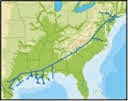
"Williams Partners L.P. (NYSE: WPZ) today announced that its Transco pipeline system received binding commitments from shippers for 100 percent of the 448,000 dekatherms of firm transportation capacity under its Dalton Expansion Project, which would support providing access to Marcellus shale gas supplies to customers in northwest Georgia for incremental electricity generation and growing local distribution load. Additionally, AGL Resources (NYSE: GAS) has entered into agreements with Williams Partners to jointly fund the Georgia lateral portion of the expansion. "The Dalton Expansion Project is one of six large-volume projects Transco is pursuing to connect approximately 3.4 million dekatherms of natural gas from surging supplies in the northeast to high-value growth markets in the southeast," said Rory Miller, senior vice president of Williams Partners' Atlantic-Gulf operating area. "By year-end 2017, we expect to add more than 50 percent to Transco's system capacity with mainline expansions that include the Dalton Expansion Project, Atlantic Sunrise, Leidy Southeast, Virginia Southside and others to meet the increasing demand for natural gas in the region."" Williams (WPZ) is an MLP and operates the TRANSCO. This is the company responsible for the proposes Atlantic Sunrise Expansion that will bisect a number of Pennsylvania Counties.
This is just the tip of this iceberg, and no doubt domestic markets are one target of this company. But what's also clear is that Mr. Graham is taking a gamble by expanding his company interests well beyond its traditional reach--and into the Marcellus Shale on the same promise of "strike it rich!" that Terry Engelder made possible. The only way to make that promise pan out for his shareholders is to expand beyond the domestic markets because while good advertising can make these markets more profitable, the pressure to realize those dollars is very very real given that, as we can already see in the Baaken, the Eagle Ford, and other shale plays, the gas will decline in production, and it will do it quickly. Hence, Graham must acgt and act aggressively before this boom goes bust.
And the Pine barrens, just like the Everglades in Florida, Tiadaghton and Loyalsock State Forests in Pennsylvania, Mount Rushmore, tribal lands across the country, and so many other places large and small, known and unknown (like you yard) hang in the balance.


