Thursday, October 17, 2013

The Unholy Alliance of Big Energy, Big University, Big State: My Exchange with Terry Engelder

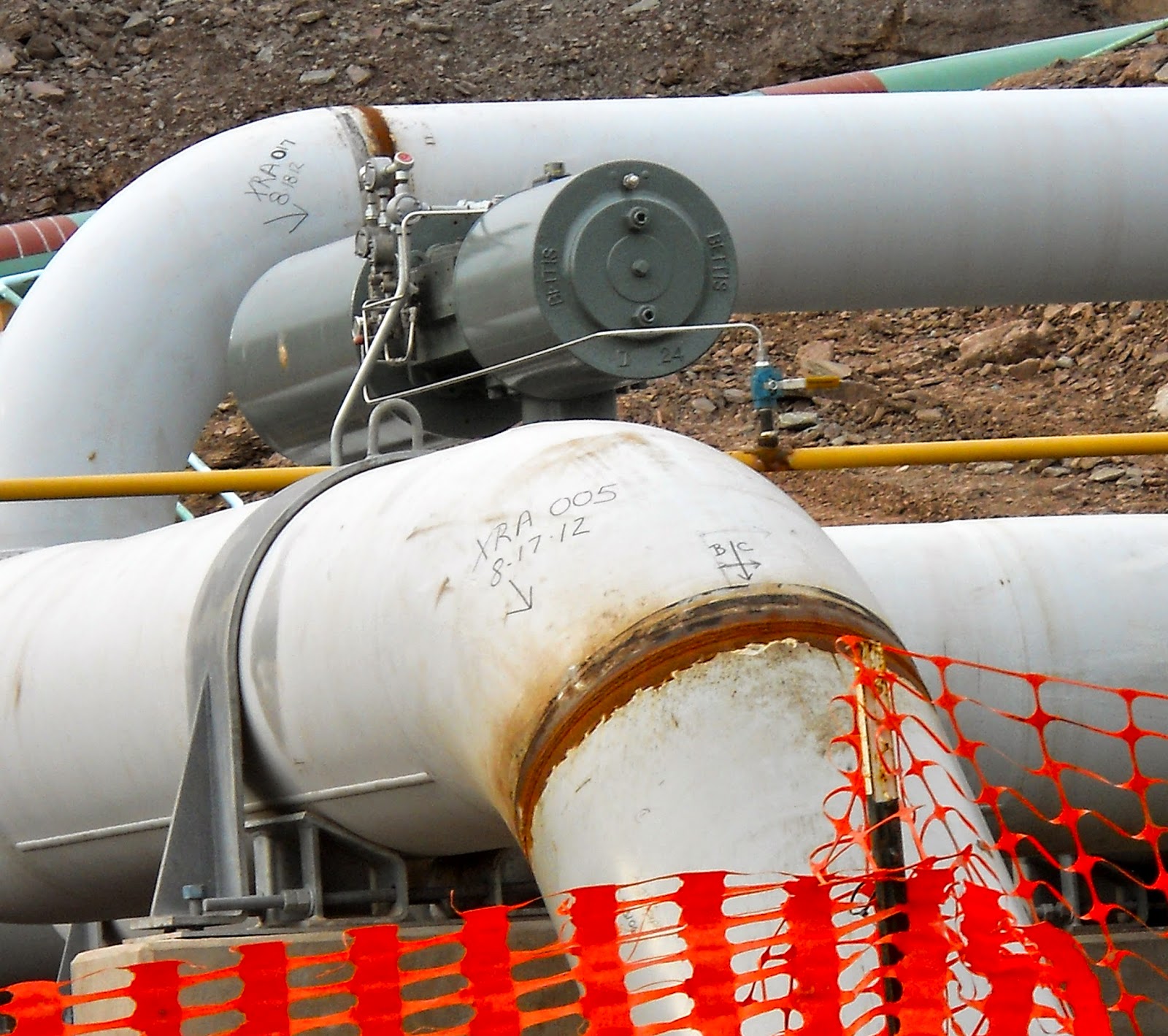
Bad Weld, TRANSCO Pipeline, CNYOG Compressor, Janet Hock Road
Davidson Township, Sullivan County, PA. 10.13.12
Photo Wendy Lynne lee


Perhaps the most incredible thing about my recent public listserv and consequent email exchange with Penn State geologist Terry Engelder is his explicit insistence that I “do not have permission to put this material on the web.” Why, I can only hazard to guess, but the substance of our last exchange may have something to do with it: I think he’s a tad bit embarrassed, and let his desire to be the “Jonas Salk” of natural gas extraction get away with him. Engelder plainly does not like me, and he does not want to have to deal with a critic.

Here’s how that cashed out in our very last exchange—and Engelder got the last word: he claims to teach a class called “Resource Wars” for which, he says, he needed material showing the behavior of “intolerant fundamentalists” in the face of “scientific evidence.” He says that he knew he could “shake” some of these folks “out of the bushes” by chatting up the Youngstown Ohio earthquakes in order to show why we shouldn’t worry about this sort of seismic activity. He claimed that I had cooperated “very nicely” in his shaking venture by taking his character to task in our correspondence, and that this was especially true in my response to the public listserv post that I have included here since it was not email (as if email were private correspondence, but whatever.). His main aim, he said, was to use me to illustrate the distinction between open and close-minded people. By “close-minded,” I gather he means “critical” or “querying” since that’s what I did. My bet is that Professor Engelder wished he could take back that last post because both in substance and in tone it vindicates my observations about his motives, namely, that they’re not entirely consistent with the academic values he claims to espouse—and that serving the mission of the natural gas industry is more important than serving that of the university. But then again—Penn State is clearly more interested in the money generated through the promotion of slickwater hydraulic fracturing than it is in the academic integrity of its institution. Professor Engelder is, I think, simply the poster child for that corporatized institution we used to call a university.

In his original post to “colleagues” Professor Engelder argues that while the earthquakes in Youngstown, Ohio and elsewhere are indeed connected to the destabilizing presence of deep injection wells, that they are of too little concern to worry about whether we should revisit the decision that requires them, namely hydraulic fracturing—fracking—a gas extraction process that produces waste-water so toxic that it cannot ever be returned to the water table and hence must be permanently (or, at least until it leaks) deposited in wells drilled deep under the earth’s surface. He draws an analogy comparing the earthquakes to the temporary ice melt caused by ice skate blades sheering across ice:

Most of you understand that ice skates work because the pressure under the thin blade of steel causes a very small amount of ice to melt momentarily. We scientists call this a pressure-induced phase change from a solid (ice) to a liquid (water). It is this film of water between the steel blade and solid ice that allows the skate to glide without effort… The water along the fault zone acted just like a water film between the steel blade of a hockey skate and solid ice. The fault in question was already subject to a push from earth stress. It is just that the push was not quite enough to get the fault to slip (trigger an earthquake).

Perhaps this seems a sound argument; I think not. Indeed, I think it’s open to some fairly critical analysis, and that was what I set out to offer in my response. That is called “being a critic” and it does not constitute libel because it is not an attack on the person, but rather the argument. If I wanted to attack Professor Engelder personally, I could have just called him “stinky.” In the follow-up correspondence—initiated by Engelder—I continued the critique of this analogy as well as of other aspects of his original post. And he continued to respond—mostly by repeating the analogy—but of course, he’s refused to allow any more public inspection of those claims despite the fact that he explicitly reserves the right for himself to use them to teach his course. In other words, Professor Engelder reserves to himself the prerogative of engaging in an exchange on the disguised intention of baiting an alleged intolerant fundamentalist into saying something stupid—and he reserves the right to use it as a pedagogical tool—all the while refusing to allow she who has said the stupid to post the exchange (or presumably use it as a pedagogical tool). If this feels hypocritical it’s because it is.

I did question Professor Engelder’s motives given his unvarnished (and undenied) use of his position as a professor at a big-name School—Penn State—to promote an industry whose extraction processes pose a serious hazard to the environment, and to human and nonhuman animal health. Calling Professor Engelder out on his professional responsibilities is also not libel—he is a university professor and a public figure. He has a professional responsibility to represent facts honestly and without bias—even where this does not jibe with what he may want to be the case. And Engelder is committed to the continuation of fracking—even if what’s required for the storage of its waste produces earthquakes. So why doesn’t he just go to the mat on this one? If Engelder is certain of his arguments, certain that he is acting in accord with his professional responsibility, certain that I am wrong on my facts, my analyses, my daring to call him out, why deny me permission to post the whole exchange? What’s he got to lose if only I look the stupid? I argued that these earthquakes have to be taken seriously, they were earthquakes that on the evidence were likely to increase in both magnitude and frequency, and that this was the sort of collateral damage caused by hydraulic fracturing we can ill-afford. I quoted his sources, and demonstrated that he quoted them out of context. I took to task his comparison of earthquakes to the ice-melt caused by skating blades arguing that this underrepresented the actual damage caused by the quakes (especially where there were large human populations like Youngstown), and I pointed out that the fluids that will inevitably leak from these wells were massively toxic (which he papers over by calling the fluids “mostly water”).

Professor Engelder was not happy—hence the contentious email exchange followed by his admission that the whole thing was a set-up to lure “intolerant fundamentalists” into becoming fodder for his course. Perhaps he thinks that because I’m “just” a state university professor I am easily intimidated by the “big gun’s” attempt to silence me. I did ask permission; he did refuse it. Well and good. I’ve not posted the exchange anywhere on the web—not because doing so is libelous, but because I honor my promises. The last time I checked, however, the first amendment still applies. I can still talk about the exchange, and I can still post his original “letter to colleagues.” To intimate he might sue me for libel shows only that Professor Engelder cares little for freedom of expression when it’s not his own, and that he cares little for the academic freedom of inquiry and exchange that defines the very mission of a university. But then again, this is Penn State.

Why bother?

Because Terry Engelder epitomizes a relationship between a university, an industry, and ultimately the state that should give us all pause—especially when that relationship underwrites an industry whose history is demonstrably rife with subterfuge, mendacity and camouflage of fact in the interest of profiteering. The original exchange was not only public—it was so public that it could serve to shake environmental fundamentalists like myself out of the bushes. Why “obviously”? Because both in strategy—a letter addressed to “colleagues”—and in content—the defense of an industrial process, fracking, against the criticism that the deep injection wells cause earthquakes, Professor Engelder not only explicitly pitches for the industry, but seeks to undermine the opposition in the minds of those who would be its future employees—hence the use of language like “intolerant fundamentalists.” There is no mystery about where he stands. In a recent interview with Ira Glass of This American Life, Sarah Koenig describes him this way:

People critical of gas drilling have called Terry Engelder an industry shill. And while it is true that his Marcellus talking points line up exactly with those of industry, I got the impression that Engelder sincerely believes these talking points. He believes industry wants to do shale drilling right, that it’s figuring out how to minimize the environmental and health hazards. And his job, his responsibility, in fact, is to help. He believes he’s had an opportunity only a handful of scientists get, to influence the course of history. He compared himself to Louis Pasteur and Jonas Salk.

Another way to put this is that Terry Engelder is manifestly not an industry shill. As my own correspondence with him bears out, this is just too simple. Indeed, I think the case may be a bit more pathological. Engelder’s investment is revealed in his comparison of himself to Louis Pasteur and Jonas Salk, two of history’s great humanitarian scientists. Consider the series This American Life where Ira Glass offers an insightful glimpse into the relationship between an academic, in this case, Terry Engelder, a university, Penn State, and an industry poised to strike natural gas gold. Professor Engelder is rightly credited with the discovery—though not undisputed—of fifty trillion cubic feet of natural gas potentially extractible from the Marcellus Shale deposits under Pennsylvania and New York. His response: “Merry Christmas America. You’re in for a real treat.” The irony could not be more poignant or more sad: he appears to truly believe that an industry poised to rape the environment upon which we all depend for the sake of demonstrable profiteering is actually interested in human welfare.

Professor Engelder apparently believes he owes it to the industry to be its Jonas Salk: “In a very real sense, this was my one opportunity to repay the faith that the federal government has had in me and the industry has had in me.” Far, however, from the image of the humanitarian scientist, Engelder takes his purported historical significance to justify mercenary subterfuge for the sake of converting a university course into an opportunity to recruit industry apostles, and to contribute to the demonizing of its critics. But his teaching moment is also mine—though my aims are radically different: understanding Terry Engelder offers a window into an industry willing to say and do virtually anything to advance its objectives—including using one of its own true believers to espouse its “transitional energy, national security, America, cheap and abundant” worldview—and to run interference against folks like me. It would be, I have come to realize, irrational for Professor Engelder to worry the loss of revenue from any fracking investments he may have—but he does have his place in history to consider, and that, it turns out, is a far more fragile thing.

What if his colleagues—the ones to whom he pretends to address his original missive— discovered an exchange that effectively interrogates the legitimacy of this place? What would they think? Professor Engelder addresses me as if I would suffer embarrassment should my own colleagues at Bloomsburg University read it. But I would suffer no such thing. I’m not, as Professor Engelder implies, made daft by “intolerant fundamentalism,” but I am acting in the capacity of a public intellectual devoted to the public good. I have no responsibility other than to tell the truth in my public and my scholarly life as a writer and a philosopher. I have neither monetary investment nor the weight of posterity to worry, and hence my responsibility is fully consistent with the academic mission of my university—and his (at least as is ought to be). It is a very different story, I think, with Penn State as This American Life helps demonstrate:

Engelder doesn’t just talk up the Marcellus Shale. “I have to make a bit of a sales pitch for Penn State,” he says. He repeatedly points out the quote, “symbiosis between the gas industry and Penn State,” and asked them to invest in research at Penn State, quote, “The type of research that’s necessary to answer some of these questions that are going to be so critical to the future of Marcellus development,” the type of research that he, himself, will be doing… Engelder has started a research project. 10 oil and gas companies are paying about $40,000 each so students can map the Appalachian Basin, showing companies where best to drill. Engelder also has a multimillion dollar project to help engineers figure out, among other things, how much pressure they need to frack wells. Penn State depends hugely on industry money, and not just on the oil and gas industry, on pharmaceutical companies, and on weapons manufacturers, and on the government. All major research universities do, not just Penn State. But Penn State’s got one of the oldest and best gas and petroleum engineering schools in the country. Without industry money, the school might not survive. Flip through this year’s awards banquet program for the Energy and Mineral Engineering students, and it’s an industry roster. They’re getting money from Chesapeake Energy, Consol Energy, Chevron, BP, ConocoPhillips, Marathon Oil. Some of these students will go on to work for these companies, and make lots of money, and give it back to Penn State, which is great for the university. But if you take a close look at how some of these donations work, you can see how entwined the university is, not just with the gas industry, but also with state government, and how all three of them are united on the topic of drilling. [my emphasis]

This is not the story of a university; it’s the story of a university beholden to an industry that has come to dictate key aspects of the university’s mission. Penn State has effectively forfeited its responsibility to act as an independent agent for the public good, and uses the professorial status of one of its celebrity own—Terry Engelder—to legitimate it. Engelder’s “letter to Colleagues” makes marketing look like education—great for Penn State, Inc. Professor Engelder is beholden not to Penn State (other than to legitimate his status), but to those corporations who fund his research into the Marcellus Shale, who fund his graduate student’s future careers, who donate enormous sums to his university—and to his place in history. Engelder’s own claim was that “the discovery [of natural gas] could be worth $1 trillion.” To be clear: I am not claiming that Professor Engelder profits monetarily through his association with the Natural Gas Industry. He may; he may not. I don’t know. What I am claiming is that Engelder epitomizes the forfeiture of academic integrity consequent on the corporatization of the university—and that in the end this impugns Penn State as a public trust. This could not be better represented than in Engelder’s own words concerning the abuse of the state’s eminent domain, takings, and mineral rights laws to appropriate private property through forced pooling: “I suspect that if the commission were to word their recommendations for pooling in a clever enough way, this would provide political cover for the governor himself. Now, the reason this is important that it come from me, for example, is that it has no credibility if someone from industry proposes this. In fact, as the commission has been criticized a great deal anyway for being top-heavy with industry types” (This American Life). In other words, Engelder knows that his appeal as a university academic offers the best possible propaganda to the industry and, as a bonus, offers cover to a state government—the Corbett administration—that’s as deeply compromised by fracking dollars as are its appointments to key agencies and positions hail from Big Energy.

At one level, my story comes down to this: I dismantled Terry Engelder’s argument for the continuation of deep injection wells, and he doesn’t like it. I offer documented evidence of the dangers of these wells, and he doesn’t like that either. I site my sources. I deconstruct his ice-skating analogy. I question whether his motives are pedagogical or propagandist. I make out the argument against the process—fracking— that generates the need for the wells. I debunk the claims made for economic growth by showing that this growth is undermined by the price we will all pay for the destruction of our environment. Mine are not the rants of a straw man—an intolerant fundamentalist—but of a citizen and fellow member of the academy who takes her responsibility to act for the public good seriously. Professor Engelder is insulted. But that is not the issue. The issue is whether I have spoken the truth. I have, and I am happy to let others judge this claim for themselves—Professor Engelder is not. The fact is that he impugns himself by demanding that an exchange he admits was intended for unstated and arguably nefarious purposes not be made public. To silence me insures against embarrassment. But once an academic resorts to this strategy, we must conclude their interests lay not in scholarship, but in the preservation of their own celebrity.

Celebrity is, however, not integrity.

And this story, a story not in the end about professors but about the relationship of a university to an industry, must be read as a cautionary tale about the dereliction of a university’s mission, the corporatization of education, and the wholesale forfeiture of the trust between the academy and the public good. My exchange with Terry Engelder, in other words, is naught but a taste of things to come when a trusted institution—the academy—becomes compromised in both its teaching and research missions by the smell of money. The sad part—and I think the ultimate explanation for his refusal to allow me to post our exchange on the web—is that Engelder’s investment in fracking isn’t about money—but it is about getting to be right—even when you’re wrong. For this concession to self-aggrandizing ego, he should be embarrassed. Penn State, however, should be ashamed.

My original exchange with Terry Engelder who addresses “colleagues.”

[Engelder]: Dear fellow citizens:

The magnitude 4.0 earthquake on New Year’s Eve outside Youngstown, Ohio, was the flavor of the week for reporters calling to ask about the most recent developments in the Marcellus gas shale industry.

[Lee]: Professor Engelder begins his address in the flippant tone that folks in my neck of the woods (academic philosophy) call the setting up of a straw—that is, by referring to reports of an earthquake in Youngstown as a reporter’s “flavor of the week,” Professor Engelder clearly seeks to create prejudice against the argument that hydraulic fracturing causes earthquakes even before evidence has been offered one way or the other. This is unbefitting a professional academic who addresses “colleagues” and who markets himself as a scholar. That Professor Engelder uses his professional credentials to market himself does not make him less a scholar necessarily—but it is an abuse of his credentials. More of this later.

[Engelder]: I hope I can add some clarity to the media hype by providing a physical explanation for what is happening in Youngstown.

[Lee]: More sensible translation given the now well-established facts: “Let me use my title as a professor to the ends of my paid employers in the natural gas industry to tamp down the ugly truths pouring out of this Pandora’s Box.”

Here are the facts:

From the Slatist, the Associated Press, and the Christian Science Monitor: “The area around Youngstown, in the state’s northeast corner, has seen 11 minor quakes in recent months, the Associated Press reports. The last was a 4.0 on New Year’s Eve that reportedly was felt as far away as Buffalo. The AP cites a seismologist who says the quakes were almost certainly caused by operations at an injection well used for the disposal of wastewater from hydraulic fracturing operations. The state has temporarily closed that well and others nearby. The theory is that when the wastewater is shot back into the ground, it can slip into cracks along a fault line and “act like a hydraulic jack” to trigger quakes, the Christian Science Monitor explains. The quakes could continue for up to a year even after the well is closed, the AP’s expert warns.”

From the USGS [United States Geological Survey] and Columbia University: “Recent earthquakes in Ohio and Oklahoma have been directly linked to deep wells used to dispose of liquid wastes for hydraulic fracturing or “fracking” of natural gas, according to geological experts. And they expect more earthquakes to come as the industry continues to expand across the eastern United States. A boom in gas production using hydraulic fracturing or “fracking” of natural gas has played a role in decreasing US dependence on foreign oil and coal and helped cut energy prices, but evidence is mounting that the process may come at a price. “To the extent that our nation wants to become independent of meetin g its energy needs in the coming years, the increased earthquakes are going to go along with that,” said Art McGarr, a geophysicist with the U.S. Geological Survey in Menlo Park, Calif. “The problems are only going to grow in the future.” State officials shut down all drilling around a brine-injection well after a magnitude 4.0 quake rumbled through the Youngstown, Ohio, on New Year’s Eve day. That was the 11th earthquake in 2011 in the region, which is not considered seismically active. Experts are also investigating a 5.6 magnitude earthquake east of Oklahoma City that has been linked to gas drilling there, McGarr said….A team of investigators from Columbia University’s Lamont-Doherty Earth Observatory has been trying to figure out the connection between the earthquakes and the injection well, which takes waste fluids from nearby fracking operations, for the past few months. John Armbruster, a seismologist on the team, said the wells trigger quakes that are already poised to occur.”

From Scientific American: “Residents of Youngstown, Ohio, received an extra surprise on Christmas Eve and again on New Year’s Eve—earthquakes, measuring 2.7 and 4.0 on the Richter scale, respectively. No one was injured and only a few cases of minor damage were reported after the Dec. 31 event. Scientists have quickly determined that the likely cause was fracking—although not from drilling into deep shale or cracking it with pressured water and chemicals to retrieve natural gas. Rather, they suspect the disposal of wastewater from those operations, done by pumping it back down into equally deep sandstone….Nine small earthquakes had already occurred between March and November 2011 within an eight-kilometer radius of a wastewater injection well run by Northstar Disposal Services. Because quakes are otherwise rare in the Youngstown area, the Ohio Department of Natural Resources in November asked Columbia University’s Lamont–Doherty Earth Observatory (LDEO) to place mobile seismographs in the vicinity to better determine what was going on. John Armbruster from LDEO installed four seismographs on November 30. By triangulating the arrival time of shock waves at the four stations, Armbruster and his colleagues needed only a day or two to determine with 95 percent certainty that the epicenters of the two holiday quakes were within 100 meters of each other, and within 0.8 kilometer of the injection well. The team also determined that the quakes were caused by slippage along a fault at about the same depth as the injection site, almost three kilometers down. Although LDEO scientists are not saying that the pumping caused the quakes, injection fluids have been implicated in other strike-slip earthquakes close to deep-injection wells. In essence, the fluids can act as lubricants between two abutting rock faces, helping them to suddenly slip along the boundary. The scientists did say that subsequent quakes from the Youngstown injections, which had been underway for a year, could continue to occur for up to another year, even if no more fluids are added. Ohio lawmakers have asked Northstar to stop operations until a full investigation is complete; the company has agreed but is not talking publicly about the events.”

In other words, the clear evidence points directly to the deep injection wells–repository for frack fluids arriving from particularly Pennsylvania—as the causal culprit of the earthquakes. The question is not whether deep injection is implicated in seismic activity but simply whether the magnitude of that activity will become greater and its incidents more frequent. Even IF (as is unlikely) it is not yet clear enough that deep injection is responsible for the earthquakes, it is certainly clear enough that a moratorium must be instituted on the process until the evidence is established one way or the other—and this includes precisely all those activities for which the deep injection wells are necessary, namely, hydraulic fracturing—or fracking.

Now to address Professor Engelder’s logic:

[Engelder]: Most of you understand that ice skates work because the pressure under the thin blade of steel causes a very small amount of ice to melt momentarily. We scientists

[Lee]: The reference to “we scientists” is insulting and dismissive—it seeks to elevate one class of educated person above others. Moreover, Professor Engelder is not acting here in his role as a scientist. He is acting as an industry representative who uses his title “scientist” to establish credibility and to make claims that are not those of science appear as if they were.

[Engelder]: call this a pressure-induced phase change from a solid (ice) to a liquid (water). It is this film of water between the steel blade and solid ice that allows the skate to glide without effort. The reason that the skate glides without effort is that this thin film of water literally lifts the steel blade off the ice by at carrying part of the load of the steel blade. You would be correct in concluding that the load of the blade is transferred from a solid-solid (steel-ice) contact to a solid-liquid-solid (steel-water-ice) contact.

Friction between the solid steel blade and the solid ice is another part of this ice skate analogy. Friction is the ratio of the push necessary to make the steel blade glide on ice relative to the weight of the hockey player. To make their skates glide heavy hockey players must generate more push than light hockey players. What if physics can turn heavy hockey players into light hockey players? In fact, the water film under the steel blade does just exactly that by ‘carrying’ some of the load of the heavy hockey player. With the addition of water between the blade and the ice, less push is necessary.

Earlier this week, the USA Today paraphrased a colleague of mine at the US Geological Survey, Art McGarr, by writing, “Since an incident outside Denver in the 1960s, geologists have known that deep injections of wastewater, placed in the ground to avoid cleanup costs, can trigger earthquakes”. Dr. McGarr was referring to the Rocky Mountain Arsenal outside of Denver where operators had some low level liquid waste that the Arsenal wanted to dump. The solution was to inject this underground. However, injection underground ‘triggered’ some earthquakes, largely because the liquid waste (probably mostly water) found its way to a fault zone.

[Lee]: Professor Engelder misrepresents the claims of USGS Art McGarr. He was not referring to the Rocky Mountain Arsenal incident. Here’s what McGarr in fact claims: “It’s reasonably clear that these Youngstown earthquakes are being caused by the disposal well activities.””To the extent that our nation wants to become independent of meeting its energy needs in the coming years, the increased earthquakes are going to go along with that…The problems are only going to grow in the future.” Moreover, the incident at the Rocky Mountain Arsenal is instructive: deep injection of wastewater can trigger earthquakes. Perhaps Professor Engelder thinks that because “causes” does mean something quite different from “trigger” that the potential damaging consequences will be less from the latter than from the former. But this faulty logic involves something rather like assuming that just because, say, the consumption of caffeine may only be the trigger of a migraine headache and not the cause that the headache itself will not be as severe. And that, of course, is ridiculous.

[Engelder]: The water along the fault zone acted just like a water film between the steel blade of a hockey skate and solid ice. The fault in question was already subject to a push from earth stress. It is just that the push was not quite enough to get the fault to slip (trigger an earthquake). When water from the Rocky Mountain Arsenal was injected along the fault, the water picked up some of the load from rock stress across (normal to) the fault. By our understanding of friction, if water carries some of the load, then the push parallel to the fault (which did not changed during injection) becomes capable of triggering earthquakes.

[Lee]: Indeed. And if even this much is true, it is compelling reason enough to halt deep injection. But in fact even industry representatives like the Ohio Oil and Gas Association worry about far more: “”We support the state’s action” on closing down this well, says Tom Stewart, head of the Ohio Oil and Gas Association.”

[Engelder]: The government (i.e., the USGS) in collaboration with industry (i.e., Chevron) wanted to understand the effect of injection on triggered earthquakes.

[Lee]: Let’s take a moment to examine Chevron’s credibility on all things fracking: In a recent and very well documented study conducted by the Sisters of St. Francis of Philadelphia, the Sisters showed that Chevron failed “to transparently disclose risks associated with hydraulic fracturing operations to investors,” and that when shareholders—including the disposal of waster water—were apprised of these risks their response was that the risks were so great that the industry must do everything possible to resist environmental and safety regulation since that regulation—from inception to disposal—would be so costly that the industry would not be profitable. In other words, the mission of Chevron—even according to its own shareholders—is to turn a profit at any cost.

[Engelder]: Consequently, a very famous experiment took place in the early 1970s at Chevron’s Rangely oil field in western Colorado in which earthquakes were systematically triggered by a plan of periodic water injection under high pressure. This work was reported in a 1976 Science paper which I attach. Shortly after the Rangely experiment in the 1970s, I was in the Soviet Union as a very small part of a team lead by Dr. David Simpson (now president of IRIS) to understand reservoir triggered (induced) seismicity. The Soviets had constructed a 1000 foot high earth-filled dam and feared that either the weight from the reservoir or water pressure along faults below the reservoir would trigger earthquakes. Again, it was, in part, about friction along faults and how water can help to reduce the push necessary to overcome frictional resistance and trigger an earthquake. Triggered earthquakes become so ‘famous’ that Hollywood chimed in with a 1985 James Bond movie, “The View to a Kill”. Max Zorin played by Christopher Walken was planning to set off an earthquake along the San Andreas fault which was to wipe out all of Silicon Valley by injecting high pressure along the fault. James Bond in the form of Roger Moore swoops into Silicon Valley just in time to save Steve Jobs’ garage from certain destruction. If Hollywood embraces the idea, you know it is NOT possible.

[Lee]: WOW! Honestly, as a fellow academic, this is just embarrassing. The fallacy here is called “ad hominem”: Attacking the person/source of a claim (in this case Hollywood) as opposed to the content of the claim (deep injection causes and/or triggers earthquakes). The source of a claim is logically irrelevant to the truth or falsity of that claim. The truth or falsity derives from the evidence and coherence of the argument in support of a claim—and that’s it. Whether the claim comes from Hollywood, the USGS, or the woman on the moon has nothing to do with the claim’s veracity. And Professor Engelder should know better. Perhaps he’d respond that he was simply aiming for levity. But that would be disingenuous—his aim is to tamp down the facts, and the resort to this staple of right-wing ridiculing rhetoric is more at home with the like of Sean Hannity than it should be with a tenured academic.

[Engelder]: Now, let’s clear the air for once and for all regarding earthquakes triggered by industry. You know that injection of water under high pressure is required for hydraulic fracturing. It should not take a rocket scientist to immediately conclude that every horizontal well drilled and stimulated by high pressure water should have triggered earthquakes and lots of them. Right?

[Lee]: This claim is patently absurd and commits the fallacy of overgeneralization: Just because not all injection of (highly toxic—a fact Professor Engelder conveniently ignores) of frack water under high pressure produces earthquakes does not mean some injection does not have this effect. As is made abundantly clear by SciAm (see above), the likelihood of seismic activity depends upon the specific geology of a region. To reiterate: “The team also determined that the quakes were caused by slippage along a fault at about the same depth as the injection site, almost three kilometers down. Although LDEO scientists are not saying that the pumping caused the quakes, injection fluids have been implicated in other strike-slip earthquakes close to deep-injection wells. In essence, the fluids can act as lubricants between two abutting rock faces, helping them to suddenly slip along the boundary.”

[Engelder]: But no one has phoned in with reports of earthquakes. The press is too sharp and too vigilant to have missed this story. Right?

As we speak, I have research contract funded by a collaboration between government and industry to study earthquakes triggered by massive slickwater fracturing. << I know, an academic-government-industry collaboration is not to be trusted or so ‘This American Life’ implied this past summer on NPR >>

[Lee]: Indeed, Professor Engelder is correct here. Because such collaborations have as their goal not truth but corporate profitability, they are in fact biased in favor of that goal. They are not to be trusted—and neither are, as Dean Marshall makes so clear in his piece on this letter, their paid representatives.

[Engelder]: Among the wells that I am studying, a typical hydraulic fracture stimulation in several stages triggered 5,853 earthquakes and these were just the earthquakes that could be detected. That is a lot of earthquakes for the press to have missed.

To date, the PADEP reports that over 4,000 wells have been drilled in the Marcellus. If we assume that my typical well is one of, say, 3,000 horizontal wells, then it seems that industry has caused at least 17,000,000 earthquakes in the State of PA over the past three years. None of these 17 million earthquakes have been newsworthy. Why?

[Lee]: What better strategy to utilize a sample of fallacious reasoning—overgeneralization and straw argument—than to simply repeat it as if its content had already been established? Except—for that it hasn’t.

[Engelder]: They can’t be felt by the local farmers because they are too small.

I should point out that the difference between hydraulic fracturing and waste disposal is in the volume of water injected. The disposal wells are vertical so a comparison with vertical fracked wells is necessary. I don’t have the exact numbers but it is likely that vertical frack stimulations are under a million gallons. I don’t know how much water has been injected in the Youngstown, OH, wells but I presume the volume is much larger. Here, volume at a point source matters and horizontal wells are not point sources which means that several million gallons is spread over a large area and so triggering ‘felt’ earthquakes is extraordinarily unlikely.

[Lee]: This reasoning is specious: (1) the issue is not that some earthquakes are too small to be felt by farmers (or anyone). The issue is that the earthquakes in Ohio could be, that they could cause damage, that their location is obviously relevant to that potential damage, and that future earthquakes—as predicted by the USGS among others—could be of greater magnitude and could—depending on their location—cause damage. (2) Volume of water does matter—and because hydraulic fracturing involves between 2-8 million gallons of water, that process both permanently removes water from the water table (hence the need for deep injection wells) and hence provides an estimate of what must be injected—except for this fact: as much as half of frack fluids are allowed to evaporate in open air pits—including their highly carcinogenic contents. But if even half of 8 million gallons of permanently contaminated water must find its way to injection wells, it is still a far greater volume that Professor Elgelder acknowledges. If he responds that that number is still too high because so much of the frack fluid is lost—we should find this cold comfort because lost means seeped back into the water table.

[Engelder]: Of course, industry and the antidrillers

[Lee]: Translation of anti-driller: Proponent of environmental integrity and human and nonhuman health.

[Engelder]: will probably take the postures that they have assumed regarding frack fluid invading ground water. Industry points to some very large numbers of wells that have been fracked without compromising ground water.

[Lee]: Also irrelevant: Given the carcinogenic and potentially radioactive toxins involved, the number of accidents involving groundwater is irrelevant. One is too many—and we have now seen many MANY more than one.

[Engelder]: The antidrillers point to a case in WVA and the Pavillion experiment to say that industry is wrong. Let me point out that hydraulic fracturing has undoubtedly triggered billions on earthquakes in the USA alone over the past 60 years, so I might conclude that the public is safe from this potential risk.

[Lee]: This can only be a deliberate obfuscation of vertical drilling and horizontal drilling for which the risks must be assessed separately.

[Engelder]: However, there is a risk and always will be. As my good colleague from the Sullivan County debate likes to point out, “Nothing in life is certain”. He’s absolutely right. The obvious conclusion is that with the triggering of billions of earthquakes during hydraulic fracturing stimulation, the probability that a felt earthquake will occur is extraordinarily low but not impossible. The punchline in the USA Today story is that, “The Ohio quake, which caused no damage, joins similar recent quakes in Texas and Arkansas linked to injections of wastewater from drilling operations”.

Among the major issues associated with shale gas production, triggered earthquakes is probably not one of them.

[Lee]: No, Professor Engelder, the punchline is that as fracking comes to involve more and more drill sites, as more and more waste water must be committed to deep injection the risks of this operation from inception to conclusion become greater as well. The punchline is that these risks are demonstrably too great both with respect to environmental sustainability and health. The punchline is about a professor who abuses his status and his prestige as a professor to shill for an industry that pads a salary already far greater than the vast majority of the citizens of either Pennsylvania or Ohio. Sadly, however, this punchline is not very funny—indeed, for Professor Engelder, it is shameful.

Fracking is a Variety of Environmental Rape Abetted by the Law: Governor Corbett’s Pennsylvania, Inc.

Perhaps the most alarming fact about hydraulic fracturing—fracking—is that it’s still going on at all despite the enormity of the evidence against it. Chesapeake CEO Aubrey McClendon must think there’s a special god just for frackers, one who not only turns a blind eye to the poisoning of life-essentials like water, but who rewards CEOs like himself with salaries that convince us there’s a special place in heaven for the masters of calculative reason without the burdens of conscience. As it must surely seem to McClendon, the prayers of corporate persons like Cabot, Chesapeake, Williams Production Appalachia, Range Resources, and Chief are being answered right here on earth, right now in the milk-and-honey land of coal and petroleum and natural gas.


And what hopeful prayers they are. What was a mistress hard-tamed by ordinary vertical drilling is, as the inimitable and perverse Frances Bacon might put it, made pliant by the horizontal fracturing of her ligaments and bones. What secreted geological and zoological history Mother Earth had refused to give up to dated technology, she can now be made to expel via the chemical abortafacients imploding inside her belly. What’s otherwise the gory expulsion of carcinogens and un-reclaimable lubricants, friction-reducers, surfactants, and biocides are magically transformed into the manna of the fracking god: money—money and all it can buy or bribe or terrorize into submission. The earth is fracked, and there is little wonder the industry would prefer to use another word; fraced sounds less like rape.

Disturbing images to be sure. But what makes such images apt is that they capture not merely the fracking process itself, but the unholy alliance being formed between the fracking industry and the state. A state that permits the irretrievable pillage of its waterways, the effective seizure of its citizens’ private properties, and the destruction of its roads, bridges, and communities for the sake of its profiteering partnership with an industry already mired in corruption. Even more disquieting is a state that crafts legislation forcing the forfeiture of the decision-making authority of its townships and municipalities to an agency of the government—the Attorney General’s Office. We might be tempted to call this fascist, but in Pennsylvania’s case the fascist is also the perverse: by trying to disguise such preemption in the corporate-propaganda of jobs, energy security, and free market capitalism, our current administration is rightly described not merely as fascist, but as a profiteering predator. Indeed, if the fracking god was going to reward a governor for terrorizing his citizens into believing that the state’s coffers were in such dire straights that only the deep pockets of the industry that financed his campaign could save them from economic ruin—and that a good patriot wouldn’t hesitate to open her heart (or lift her skirts) to the good folks at Cabot, Chesapeake, et. al., who are all for America, apple pie and freedom—it’s Tom Corbett, CEO of Pennsylvania, Inc.

And this brings us back to rape—and hype. For however much “friends of natural gas” like Corbett and his Big Energy Industry appointments (say, Alan C. Walker) dress themselves up as job-bearing, America-n-freedom-loving sheep, they are wolves whose actions prove beyond doubt that when bribery falters, force is sure to follow, or that when old-fashioned patriotic guilt-mongering doesn’t do the trick, a shiny-new law wrapped up in the flag will.

Enter House Bill (HB) 1950 and its twin Senate Bill (SB) 1100. These bills would establish an impact fee on producing gas wells. In exchange, municipalities forfeit zoning powers granted to them under the Pennsylvania Municipality Planning Code (MPC). Any local government that has an ordinance that is as permissive or more so than the state’s standardized zoning ordinance gets revenue from the impact fee; more producing wells, bigger fee (note that fracked but non-producing wells net precisely nothing other than whatever potential environmental damage they leave behind). Any local government whose ordinances are less permissive doesn’t see a dime even if its municipality is home to multiple wells, compressor stations, transmission lines, or processing plants . The bill, in other words, effectively exempts the natural gas and oil industry from municipality-imposed zoning ordinances, and while we might hope that the state’s standardized zoning code would offer protection from at least the most egregious of industry abuses, “lax” doesn’t remotely describe Pennsylvania’s current oversight of the industry. In fact, we might rightly see HB 1950 and SB 1100 as a bribe to look the other way.

If you think all the action is going on at Dimock where the state has liberated Cabot from having to truck in water to replace what its well blowout contaminated forever, think again. Just for starters, from the December 10th, 2011 edition of the Philly Daily News:

A veteran welder, now an organizer for a national pipeline union, happened upon the line and tried to blow the whistle on what he considered substandard work. But there was no one to call. Pennsylvania’s regulators don’t handle those pipelines, and acknowledge they don’t even know where they are. And when he reported what he saw to a federal oversight agency, an inspector told him there was nothing he could do, either. Because the line was in a rural area, no safety rules applied.

Sound like a state invested in the public good? Hold on. A municipality’s date with the frackers only gets better. According to Protecting Our Waters, a water conservation group, these bills “would…strip local municipalities right to stop drilling in flood plains or to stop massive water withdraws from residential neighborhoods.” HB 1950/SB 1100 can, in effect, eradicate entire neighborhoods, and replace them with industrial zones by transferring to the state decisions about where gas wells can be located—including decisions about the distance from essential community assets such as schools, churches, forests, wetlands, and waterways. Why should Range Resources have to go to all the trouble to sue South Fayette Township over an ordinance that requires a $5000.00 permit to frack a well and respect buffer zones around schools and hospitals when HB 1950/SB 1100 can simply preempt the township? According to Range Resources, the Pennsylvania Oil and Gas Act already bars townships from this sort of intrusion on their frack-plans—but if that’s not a guarantee, the new law will clear it right up in favor of the corporation.

How about a little noise with your church? Maybe a little truck “fraffic” with your quiet-time? Or at your kid’s school crossing? “Local ordinances would not be allowed to restrict the hours of gas drilling operations at all. No restrictions on light, noise, or height could be imposed…no restrictions on the vehicular access of routes for the heavy trucks could be implemented.” And just to add insult to injury, the state plans to permit the use of frack fluids as Winter de-icer; perhaps school buses can just follow the frack trucks. The upshot: if this legislation passes, municipalities in Pennsylvania will effectively exist at the pleasure of the natural gas corporations. Whether you’re a private property owner (thanks to forced pooling and public takings) or a municipality, the romantic notion that you have a say about fracking is nothing more than a pretext to get you to lease your land or sell out your fellow township board members voluntarily. Easier for the frackers that way. But no matter. Go ahead. Resist.

Imagine a dialogue between Ms. Municipality and Mr. Fracker:

Ms. Municipality: Mr. Fracker, I really appreciate your offering us an impact fee and all, but, well, if there’s a big fracking accident—like that blow-out from the faulty casings in Dimock—that money is going to get itself spent real quick. And besides that, my folks just aren’t real comfortable with the prospect of all those trucks on our two lane roads, compressor stations next the elementary school, rising cancer rates, the prospect of radioactive waste, and that flaring all night. I mean at first, it was kind of pretty—but honestly, the allure has worn off. So, thanks for the offer, but no thanks.

Mr. Fracker: Ms. Municipality, I understand your concerns, but frankly you’re just in my way. The law assures me I don’t have to give a fracking-fuck. I thought if I took you on this nice date with the impact fee flowers and all, you’d make it easy. But here you are calling it fracking. I prefer fracing. But whatever. Here’s your choice: You can survive or you can die. I can’t help it if the first choice feels like prostitution, and the second’s unthinkable. This is Pennsylvania, Inc., and there’s money to be made.

The only real difference between the fracking of a well and that of a municipality is that the latter comes dressed like sheep on a date, offering little niceties with pretty names like “impact fees.” But, fracking-god forbid, the municipality turns down a suitor from, say, Cabot. As the overwhelming evidence makes clear, “no” means nothing but “frack me, and frack me hard.” Indeed, should the municipality protest with antiquated notions of “rightness” and “wrongness,” should its citizens appeal to starry-eyed ideas like “health,” “community integrity,” or “property rights,” well, thanks to SB 1100 and HB 1950 (not to mention a long history of coal and oil friendly law), such moral simpletons can now be made every bit as compliant as the chunk of Marcellus Shale formation blowing its gas out along faulty transmission lines into their aquifers and streams (thanks to fractivist Dean Marshall for reminding me the value of plain references to “right” and “wrong”). Folks who refuse to sign leases “had in coming.” They “asked for it” by buying frackable land. They could have made some cash by allowing a little frack-action, a little drilling-down—you know they really wanted it—but the industry-wolves are getting tired of dating. Thank the fracking god the law’s come to the rescue.

The moral of my story: If you think the horror of fracking ends at the drill site, you just don’t know what environmental rape really is. And if you think that to deploy language reserved to the violence of sexual assault doesn’t describe what’s coming to our municipalities, our communities, our properties and homes, you’re not paying attention. A government beholden only to those whose aims are the manufacture of profits is one for whom the public good becomes naught but the cynical propaganda of the enterprises it calls bedfellow. Fracking becomes the patriot’s concession to national security. “Clean and Abundant” promises to make us safe and sound all the while it fracks us over. The name of this government is corporate fascism, and as it’s willing to deploy any weapon to consolidate its prerogative, it should come as no surprise that the consequences of fracking for the environment, for human and nonhuman animal health, and for the communities in which we live are of as little concern to it as they are to the frackers themselves. Such is the nature of calculative reason without conscience. For it rape is but a tool to the ends of profiteering.

July, 2011: An Open Letter to Governor Corbett

Governor Tom Corbett:

After having carefully read and digested your proposal for the Pennsylvania budget of 2011, after having considered the relevant facts concerning the Commonwealth’s fiscal health, the relationship of the state to its constitutional responsibilities, and particularly your proposal for cutting by 54 percent the state appropriation for the Pennsylvania State System of Higher Education (PASSHE), we, the undersigned, must conclude that your motives have little to do with the current recession—and everything to do with an ideologically motivated agenda that aims to privatize and corporatize institutions traditionally identified as public goods. It’s evident, moreover, that part of that agenda is to undermine Pennsylvania’s public unions by starving the institutions that employ union members. We are compelled to conclude this for a number of reasons:

1. Failing to tax natural gas extraction:

You claim the state is on the brink of fiscal disaster and must fill a $4 billion dollar budget shortfall; yet, you refuse to impose a severance tax (or any tax) on Marcellus Shale Drilling. You claim that the drilling companies will go elsewhere were such a tax imposed. False. Ninety-six percent of states that drill for natural gas impose a severance tax—including the largest gas drilling state, Texas. No evidence supports the claim that companies drilling in those states are threatening to leave. What discourages gas drilling, according to a respected University of Wyoming study, isn’t taxation but rather the market price of natural gas. Moreover, the Marcellus drilling fields are limited—drilling is only possible where it is possible—and this suggests that companies like Cabot and Penneco aren’t going anywhere. Indeed, their profit margins promise nothing but substantial future gains, and at a 5 percent tax (akin to West Virginia’s), that was closely regulated to prevent customer gouging/passing the expense on to customers, a projected minimum of 200 million a year could be raised to fund essential social services and education in what some are now calling the Saudi Arabia of natural gas extraction.

You also claim that drilling will bring wealth and jobs to Pennsylvania, but this too is false on the evidence. In fact, profits from natural gas extraction exit the state at about the same speed at which the environment is destroyed. Even worse, as Pro Publica reports, “the state’s oil and gas inspectors have been stripped of their power to issue violations to the drilling companies they regulate,” increasing profits for the drilling companies at the cost of Pennsylvania’s environment and its citizens who will no doubt shoulder the burden of restoration after the drillers have left—including the restoration of 74,000 acres of state forest land. You insist that “we need to send a powerful message to the Pennsylvania Business Community that Pennsylvania is open for business.” Indeed you have—at the cost of every citizen of the Commonwealth who works, goes to school, attends a state university, drinks Pennsylvania water, utilizes Pennsylvania social services, or has any sense for the fairness and equity embodied in the Pennsylvania Constitution.

2. Ideological motivation:

Given the clear economic advantages for taxing natural gas extraction, we must surmise that your opposition to it is either ideological or self-serving—or both. Fact: You received more than $800,000 in donations from drilling corporations for your gubernatorial campaign. Fact: in delegating some of the state’s most critical environmental decisions over to Alan C. Walker (appointed to head the Department of Community and Economic Development), CEO of Bradford Energy and Bradford Coal—a corporation who donated $184,000 to your campaign—you have effectively put a fox in charge of the henhouse as ProPublica reported:

Walker’s ties to the energy industry are deep. He is listed on state disclosure forms as an executive of the Pennsylvania Coal Association and he has served as chairman of the Pennsylvania Chamber of Business and Industry…[L]ike many energy companies, his, too, have run into problems with the state. In 2002, three of Walker’s coal companies notified Pennsylvania’s Department of Environmental Protection that they had run out of money and were going to stop treating the 173 million gallons of polluted water they produced each year and released into tributaries of the Susquehanna River. The state eventually got a court injunction to force them to continue treating the wastewater as required by state and federal law.

Why, Governor Corbett, should we believe that your investment in natural gas extraction has to do with anything other than an ideology that seeks to maximize private profit of a public good—all the while padding the pockets of your political and business allies? Why shouldn’t we think you endorse a new suggested slogan for Pennsylvania: PA, Inc.—like OH, MI, and WI only dirtier, poorer, and dumber? Taxing natural gas extraction (a) would not drive any relevant corporation out of the state, (b) would provide for significant state revenue to fund social services, education, and a department of environmental protection able to do its job. What is the argument against it?

3. An end to publicly funded state universities:

This brings us directly to your proposal to lacerate the funding of PASSHE. In addition to refusing to tax gas extraction—and in the same week you drastically reduced funding for health services for the poorest of Pennsylvania citizens—you offered $833 million in tax breaks to corporations who do business in a state which already taxes fewer than 30 percent of corporate enterprises: “Governor Corbett announced that Pennsylvania’s corporate tax will allow corporations to follow federal accelerated bonus depreciation rules adopted as part of the tax cut compromise in December. The rules allow companies to write off or “expense” 100% of equipment purchases made in the last quarter of 2010 and all of Tax Year 2011…Bonus depreciation goes to investment in other states not just Pennsylvania. Companies do not have to purchase equipment in the state to take advantage of the provision. Thus the bonus may lead to no new investment in the state” (Pennsylvania Budget and Policy Center). In other words, such a give-away will not benefit Pennsylvanians. Nonetheless, to finance this generous gift to your corporate allies, you propose devastating education—leaving local school districts and their taxpayers to foot the tsunami-sized bill coming their way, undermining education at the K-12 level, and insuring that students are under-prepared for college.

To add insult to injury, you also propose cutting state funding to the very colleges and universities that middle and working class families have depended on for generations to educate their children, the PASSHE. Ninety percent of PASSHE students are Pennsylvanians. Hence, the perversity of your reasoning on this matter can hardly be overdrawn: You insist that PASSHE universities have failed to “live within their means,” and that the evidence of this is found in rising tuitions—but you fail to acknowledge that state funding for PASSHE has already been cut to less than one third of total funding. It is, moreover, false to claim that PASSHE has failed to “live with its means.” In fact, three PASSHE universities, West Chester, Millersville, and Bloomsburg made Kiplinger’s prestigious list of the 100 best state universities in the United States. Their criteria: “the best education at the best price” (apscuf.wordpress.com). Facts: “In FY 2010-2011, PASSHE will receive nearly $8.3 million less in state funds than it did in FY 2001-2002.Tuition increases have been below the rate of inflation in four of the last six years…Controlled for inflation, the System will operate with 13% fewer dollars from all sources per student in FY 2010-11 than it did in FY 1999-2000. Despite fiscal challenges, PASSHE continues to offer the lowest-cost baccalaureate degree programs in the state. However, the combination of flat state funding and low tuition increases has created historic shortfalls for the universities, which, if continued, could translate into viability issues” (www.passhe.edu).
Add another 54% cut in funding, and here’s what “viability issues” means in plain English:

A 25-33% rise in tuition that will exclude many deserving Pennsylvania citizens from being able to access higher education.
The laying-off of faculty, particularly adjunct faculty, and the resultant loss of courses and opportunities for students.
The inability to attract high quality faculty to the state, and the resultant loss of the quality instruction which PASSHE can clearly demonstrate that it provides. Indeed, at least four PASSHE graduates are appointees in your government.
The expansion of class size, and the resultant loss of high quality instruction made possible by smaller classes and access to professors.
Brain drain from the Commonwealth as students seek educational opportunities elsewhere in the pursuit not only of their dreams, but their economic wherewithal.
Campus closures and the resultant loss of access to students to higher education in their communities.
No valid argument can be made for cutting funding for university education in Pennsylvania. Indeed, there is every argument for funding education at a much higher level, especially if you mean what you say, namely, that you want to see a citizenry fully equipped to participate in the global economy. Moreover, as J.L. Helms argued in 1985, “[s]tates and local tax increases significantly lower economic growth when the revenue is used to fund transfer payments, but when the revenue is used to finance improved public services such as education, highways, and public health and safety, the impact on location and production decisions provided by the enhanced services more than counterbalance the disincentive effects of the associated taxes” (Helms, 1985). The consequences of eviscerating support for education, especially for middle class working families will be a blow for their aspirations and their communities. Hence, again, we are compelled to wonder what are your motives; they cannot be preparing Pennsylvanians to live and thrive in a globalized world; they cannot be to encourage what is essential to a thriving culture—the humanities, arts, and music; they cannot be what the Pennsylvania Constitution explicitly specifies is the responsibility of the state—the education of its citizens and the provision of their basic welfare.

4. The destruction of public sector unions:

Much like your apparent aims in effectively selling off Pennsylvania’s environment and resources to natural gas interests, your aim in undermining PASSHE funding is to see the end of the state university system in Pennsylvania, to see, in other words, a fully privatized, for-profit, university system. But the only way to accomplish this—much like what are perhaps your models in Ohio, Michigan, Indiana, and Wisconsin—is to destroy the one real obstacle in your way—the public sector unions. Unlike Governor Scott Walker who committed a political blunder in seeking to destroy collective bargaining rights for state workers in Wisconsin through legislation, you have in fact executed a far more insidious strategy of starving public sector unions like APSCUF (The Association of Pennsylvania State College and University Faculties) by starving their institutions of funding. One way to force the state universities to either privatize or close is by cutting the funding that supports their central missions—a mission instantiated by their faculties who, through the power of collective bargaining, are the bedrock of the excellent education offered by the PASSHE. As you surely must know, what such devastating cuts will mean is that the dream of higher education for thousands of Pennsylvanians will come to a grinding halt next year. We can only gather that you regard this as an acceptable casualty in the drive to corporatize higher education in the state.

This agenda is unconscionable, and it is premised on the erroneous view that the budget deficit is the product of funding for public services and goods. It is not. Rather, it’s the result of licentious gratuities to corporate entities—some from whom you directly benefit. This has likely contributed to forty-one percent of your own Republican Party members recently assessing your performance as “poor.” The rallies on the steps of the state house also clearly show where the vast majority of PASSHE students stand, particularly the Lock Haven students who ran one hundred miles to get your attention. A Franklin and Marshall College poll demonstrates that two thirds of Pennsylvanians oppose the budget cuts. In fact, these same Pennsylvanians who generally oppose tax hikes made clear they support taxing Marcellus Shale drilling in the interest of funding education (www.pennlive.com). Given all of the facts, Governor Corbett, what could justify what amounts to the re-invention of the Commonwealth as Pennsylvania, Inc. other than that this is precisely your goal? The problem, of course, is that the Constitution of Pennsylvania is a charter for a state—not a business plan for a corporation.

For the sake of the state and especially its citizens, we hope you will reconsider this ill-fated ideological agenda for the sake of your state and its citizens.

Tuesday, September 18, 2012

The Corporatization of American Democracy, Genocidal Profiteering, and Slickwater Hydraulic Fracturing: The Extortion of “The Good American”


Of all the potential crises that threaten to undermine the grand experiment called “American Democracy,” that which poses the greatest and most existential danger to its very conditions is the rise of the “shale play,” that is, the rise of horizontal, slickwater, hydraulic fracturing for shale-bound natural gas. Sponsored by some of the biggest and most morally compromised industries flying the American flag—Exxon, Shell-Mobil, Chesapeake, Halliburton, BP, Chevron—the threat posed to clean water, breathable air, private property, public lands, and community integrity is well-established.


It’s thus no surprise that such corporations—and despite their demonstrable paucity of interest in prioritizing American economic needs—appeal to the patriotic predisposition and sentiment of “the good American” to effectively extort consent.


I live and work in Pennsylvania.


Making my state attractive to corporations through the guarantee of minimal regulation, access to non-unionized workers, the use of eminent domain, forced pooling, mineral extraction rights, and a pro-fossil fuel state policy agenda very quickly became translated into the patriotic rhetoric of self-sacrifice by any American who wishes to be perceived as a good citizen, the advocate of freedom, the stalwart patriot—the good American.


This rhetoric resonates deeply in rural counties and municipalities like mine. Columbia County, PA, where I live twenty-five minutes downstream from a (now apparently abandoned, but forever toxic) frack operation, and another 20 minutes from a fracking-water withdrawal station on Route 11 directly adjacent to the Susquehanna River.


Over the last several years, this process of extraction which requires the generation of a miniature earthquake to release natural gas from shale deposits deep under the ground has begun to attract considerable public attention, both for its offer of well-paying jobs, and because of the dangers of its specific extraction processes, and its many ancillary enterprises, for example, the use of enormous quantities of sand requiring cross- country transport, its use of highly toxic combustible chemical solutions, its permanent removal and contamination of billions of gallons of water, its methane contribution to greenhouse gases, and its need for thousands of compressor stations, not to mention leaky transmission lines.


The controvery escalates daily, and sometimes violently. But it’s hardly surprising when the stakes not only for the democracy, but for life, are so high. Hence it’s also not surprising that the fracking corporations would appeal to that rhetoric most likely to be effective in the effort to quell the resistance to the destruction of the necessary conditions of life—that of the good American who is willing to sacrifice life and limb for his or her country.


The language of “energy independence,” “energy security,” “free enterprise,” “the entrepreneurial spirit” were quickly appropriated by corporations like Chesapeake who promise “Cheap, Abundant, and American” in their advertising and who insist that they can be trusted because, after all, they’re American too. Those who dared to challenge this appeal to patriotism were quickly cast as un-American, anti-capitalist, anti-progress Luddite enemies of the state—an image easily promoted through industry propaganda to further justify the state’s legislative usurpation of the prerogatives and responsibilities of townships and municipalities to regulate “shale play.” Films like the American Petroleum Institute’s “Truthland” (http://www.truthlandmovie.com/), and aggressive advertising websites pretending to offer expert testimony and advice like Energy in Depth (http://www.energyindepth.org/) are saturated in patriotic images and slogans which make clear that fracking is the American way—and that anyone who questions the authority of either state governments who subsidize the industry or the industry itself is ripe for target as, for example, a “socialist,” or “Communist.”


Or worse.


As reported in Common Dreams March, 2012 (https://www.commondreams.org/headline/2012/03/11-2), anti-fracking activists are increasingly the targets of FBI surveillance (even as reports of “eco-terrorism” are on the decrease), and the use of state and local police to insure industry prerogatives is becoming commonplace (http://truth-out.org/news/item/10005-police-raid-anti-fracking-encampment-in-pennsylvania).


Despite the obvious risks, however, a growing movement of activists, fracktivists demanding not a moratorium but a ban, has begun to take hold in Pennsylvania, galvanized by a first-hand experience and an informed understanding that fracking threatens not only the environment in its aesthetic and recreational dimensions, but the very water, air and soil necessary to life, that it threatens a way of life—especially for rural and semi-rural Americans.


It’s richly ironic that many of these folks would not identify as environmentalists. In fact, notions like “sacrifice for country” are for them powerfully persuasive in light of their rural, military, and working class experience. Nonetheless, as the evidence of the real risks of fracking mounts regarding the safety of the process, the pollutants involved, the damage to community infrastructure, the long-term health effects, and the destruction of hunting lands/fishing waterways, even some of the staunchest of patriots have begun to find themselves at town hall meetings sitting across from Big Energy executives—but not on their sides.


To be clear these risks include at least the following 16 items:


1. The toxicity of the chemicals involved in the fracking process itself, and the veritable certainty that these will migrate eventually along fissures in well-casings into ground water.
2. The necessity of deep injection wells for the permanent disposal of wastewater that is no longer usable by human beings.
3. The actual earthquakes the USGS associates with deep injection wells, and the potential dangerous fissures to well casings caused by a repeating pattern of seismic activity.
4. The already patent environmental destruction, pollution and noise hazards caused by compressor stations, transmission lines, and water withdrawal facilities near public schools, hospitals, and other community assets.
5. The nearly complete absence of regulation in “Class One” rural areas with respect to the construction and monitoring of transmission lines in and out of compressor stations.
6. The destructive consequences for the sensitive ecologies and endangered species of state park and forestlands.
7. The potential extinction of whole species of microorganism—some of which likely remain uncatalogued or even undiscovered—and who make their home in shale deposits.
8. The actual erosion of roads and bridges due to increased heavy truck traffic.
9. The actual emission of diesel and other carcinogens from trucks idling for long periods at frack sites, water withdrawal stations, and compressor stations.
10. The risk of carcinogen exposure to human and nonhuman health from the frack site wastewater deposit pools and from compressor stations.
11. Community conflict destined to erupt between those who lease and those who refuse to lease, some of whom now claim they’ll have to be shot before the state can take their land under the guise of recognizing the lease of mineral rights to energy corporations.
12. The erosion of private property rights by those who would decline a gas lease and who are then subject to compulsory condemnation, forced pooling, and the appeal to eminent domain by the state--all in the interest of allowing the gas corporations to not only frack on such properties, but construct roads, waste pits, and transmission lines in and out of a fracking operation.
13.The effective neutering of municipalities and township boards to govern the infrastructure of their communities under Pennsylvania’s Act 13 which delegates the power to determine the construction of a fracking operation within a municipality to the Sate Attorney general’s Office.
14. The actual use of fracking wastewater as road de-icer in winter despite its carcinogenic properties.
15. The harmful effects of Act 13’s gag order which prevents physicians from releasing vital information to patients exposed to frack fluids in the event of illness. This information includes the composition and amount of chemicals like Benzine, Deisel, naphthalene, toluene and xylene
16. The potentially hazardous effects for neighboring towns, municipalities, and even states of items 1-15.


My aims here, however, are not about—at least directly—any of these sixteen items—all of which are well established and publicly available.


My claim is that fracking is a concrete, visually compelling epitome of the much bigger crisis of American democracy, namely, the corporatization of state and federal government through, among other tactics, appropriation of the patriotic and thereby manipulative and disarming discourse of the “good American.” The consequences of this appropriation include not only a fundamental and potentially irrecoverable corruption of the very language and imagery of the public good, but substantial risk to the conditions upon which this good depends—clean water and breathable air. Unlike other current dimensions of the crisis—the collapse of the banks, or the wreckage of the housing markets, for example fracking endangers the conditions of life itself,not only in terms of toxins and other irrecoverable pollutants, but in virtue of (a) the permanent removal of water from rivers, ponds, and lakes, and (b) the concentration of pollutants in the what water remains.


Fracking effectively converts a necessary condition of life into a marketable and unrecyclable commodity, and it’s no real wonder that this demands a propaganda campaign that can either conceal this fact or make sacrifice to it seem worthy and honorable—even a patriotic duty.


The cynical appropriation of catch-phrases like “national security” and “standard of living” reveals an industry whose key decision-makers know the dangers of their production processes, and thus know that their “justificatory” rhetoric must include a strategy for neutralizing those who would organize to resist it. What better strategy than the appropriation of the “good American” against which—especially in the contemporary political climate—those who resist can be cast as “Leftists,” environmental whackos,” “tree-huggers,” “Communists,” or “un-American”? As anti-patriots against whom the police, the National Guard and the Army can be deployed? Traitors to country who can, if necessary, lose their lives for the sake of “national security”? Or at least be arrested and detained, (see, for example, http://www.evesun.com/news/stories/2012-05-25/14919/Afton-anti-fracking-activist-arrested-in-Albany/).


On March 9, 2012 President Obama signed into law a bill (H.R. 347) that makes protests at political events at which Secret Service agents are deployed to protect anyone one present illegal—even if the presence of the agents is unknown to the protesters. The bill effectively makes even non-violent protest subject to police harassment since the protesters have no way of knowing whether they are in violation of the law. Not only, then, does government have a new means by which to repress dissent, it will have one more tool for identifying the Good American—he or she who does not engage their first amendment rights at all:


"The US House of Representatives voted 388-to-3 in favor of H.R. 347 late Monday [2.6.12], a bill which is being dubbed the Federal Restricted Buildings and Grounds Improvement Act of 2011…Under the act, the government is also given the power to bring charges against Americans engaged in political protest anywhere in the country…In the text of the act, the law is allowed to be used against anyone who knowingly enters or remains in a restricted building or grounds without lawful authority to do so, but those grounds are considered any area where someone — rather it’s President Obama, Senator Santorum or Governor Romney — will be temporarily visiting, whether or not the public is even made aware. Entering such a facility is thus outlawed, as is disrupting the orderly conduct of “official functions,” engaging in disorderly conduct “within such proximity to” the event or acting violent to anyone, anywhere near the premises. Under that verbiage, that means a peaceful protest outside a candidate’s concession speech would be a federal offense..." (http://www.economicpolicyjournal.com/2012/02/houses-passes-new-bill-that-would-make.html).


The critic might, of course, object arguing that protests in isolated settings like remote forests or deserts are still an option, but this, of course, defeats the purpose of bringing public awareness to the issues connected to fracking. Though perhaps at first blush not obviously tethered to the corporatization of government, such a bill (1) effectively criminalizes protest—including that engaged by anti-fracking activists—since there is no way of knowing whether a Secret Service detail might not be present at at a politically sensitive event attended by CEO’s of Big Energy corporations, and (2) makes dissent against government sanctioned corporate policy that much more unlikely—protecting corporations under the guise of protecting the public.


Consider, for example, a recent event at Kutztown University, Kutztown PA, where Lt. Governor of Pennsylvania Tom Cawley defended the claim that state universities should be willing to “work with the gas companies” who may want to drill on college campuses in the state. Among the members of the audience were anti-fracking protesters, one of whom, Sean Kitchen (who stood with his back to the Lt. Governor and his panel), made the claim that “[w]hat you're saying is that you endorse poisoning college students across the state?” In combination with an increasingly dominant national rhetoric that identifies the good of corporations with the economic health of the country, protesters like Mr. Kitchen are not only likely to be criminalized but, in fact, worse—cast as outside American citizenship. Laws that effectively criminalize protest send a clear message: the place of a citizen is acquiescence. To protest government sanctioned corporate enterprise is to take up a position against the government. The good American does not behave this way.


Such a democracy, I suggest, is not merely in crisis; indeed, to the extent that the very narrative of citizenship has been co-opted to ends having naught but coincidentally to do with life, liberty and the pursuit of happiness, and everything to do with profits and share-holder portfolios, “democracy” has itself become just another advertising slogan: we are free to wave our flags while bulldozers take down our trees and tear up our land to make room for access roads, frack pads, compressor stations, and transmission lines. In fact, if you’re lucky enough to live in a class one region of Pennsylvania—fewer than ten houses per a square mile—you’re free to imagine yourself in a kind of Wild West. No regulations govern the construction of gas transmission lines where you live at all. And according to the new national patriotic narrative, only he or she who fails to have the nation’s interests at heart or who simply does not understand the immense benefits to the economy would deign to complain that this is not “freedom,” much less stand and accuse the gas industry of poisoning American citizens for profit.


Such a citizen-dissenter is not Aubrey McClendon, the CEO of the nation’s largest energy corporation, Chesapeake Energy, who deploys the rhetoric of the Good American at least indirectly by appealing to economic and energy security. As reported by Jeff Goodell of The Rolling Stone “To hear him [McClendon] tell it, the cleaner-than-coal fuel he produces will revive our faltering economy, free us from the tyranny of foreign oil and save the planet from global warming” (http://www.rollingstone.com/politics/news/the-big-fracking-bubble-the-scam-behind-the-gas-boom-20120301#ixzz1nydj2Wn2). McClendon’s appeal to love of country, however, conceals a very dark underside, one surely about “country” and “love,” but not about democratic decision-making, much less the good of his fellow citizens. Goodell continues:


"[W]hat McClendon leaves out is the real nature of the business he's in. Fracking, it turns out, is about producing cheap energy the same way the mortgage crisis was about helping realize the dreams of middle-class homeowners. For Chesapeake, the primary profit in fracking comes not from selling the gas itself, but from buying and flipping the land that contains the gas. The company is now the largest leaseholder in the United States, owning the drilling rights to some 15 million acres – an area more than twice the size of Maryland. McClendon has financed this land grab with junk bonds and complex partnerships and future production deals, creating a highly leveraged, deeply indebted company that has more in common with Enron than ExxonMobil. As McClendon put it in a conference call with Wall Street analysts a few years ago, "I can assure you that buying leases for x and selling them for 5x or 10x is a lot more profitable than trying to produce gas at $5 or $6 per million cubic feet."" (http://www.rollingstone.com/politics/news/the-big-fracking-bubble-the-scam-behind-the-gas-boom-20120301#ixzz1nyh45m9W).


It turns out, in other words, that even the patriotic rhetoric of “cheap and abundant” natural gas is simply a cover story for the acquisition and marketing of land—land that used to be rural America. This rhetoric demotes the national interest, the common good, to transferable real estate. To identify the good of this corporation with the health of the country is to identify the health of the country not with the freedom of its citizens, not with the stability or strength of its democratic institutions, but with its market value—fifteen million acres in McClendon’s case. The state, moreover, has not only become an enthusiastic player in what Arthur Berman, respected energy consultant, calls a Ponzi Scheme, it is now engaged in the erection of laws—including laws that criminalize protest—aimed at protecting what now must be called America, INC.


This, I suggest, is death-by-profiteering for the country and for its citizens—literally—and no industry more pointedly epitomizes it than Big Energy. Corporate appropriations of patriotic rhetoric are, of course, by themselves nothing new. It’s also nothing new that the “good American” is expected to lay down her/his life for the sake of country or national interest. Such is the oath of the soldier. It’s not even new that such soldiers have been co-opted to fight and die in wars for the sake of preserving and advancing corporate interests wrapped—also literally—in the flag. Such is the case in Iraq.


What is new, however, is that because the process for extracting natural gas in the Marcellus or Utica Shale Formations involves massive quantities of an essential resource—water—whose contamination requires its permanent exclusion from any use other than fracking, “sacrifice” can only be measured in terms of what lack of access to clean water means for those who are dependent on that access, namely, human beings, farm animals, wildlife, crops, forests, etc—in other words, living things. It is at least a crisis for democracy that, as good Americans, we are being asked to sacrifice not merely clean water but water per se. That the rhetoric of this sacrifice should be cast in the language of “energy security” by entities that stand to make billions of dollars not only from it but from the enormous swaths of land required to pursue it, is more than a crisis; it is, I think, either the democracy’s death sentence or, if we’re lucky, its clarion call to foment revolution.
I had originally conceived this notion of “laying down” for one’s country as a variety of rape dressed up as a date. I argued in a piece titled “Fracking is a Variety of Environmental Rape Abetted by the Law: Governor Corbett’s Pennsylvania, Inc.:”


"[I]f you think the horror of fracking ends at the drill site, you just don’t know what environmental rape really is. And if you think that to deploy language reserved to the violence of sexual assault doesn’t describe what’s coming to our municipalities, our communities, our properties and homes, you’re not paying attention. A government beholden only to those whose aims are the manufacture of profits is one for whom the public good becomes naught but the cynical propaganda of the enterprises it calls bedfellow. Fracking becomes the patriot’s concession to national security. “Clean and Abundant” promises to make us safe and sound all the while it fracks us over. The name of this government is corporate fascism, and as it’s willing to deploy any weapon to consolidate its prerogative, it should come as no surprise that the consequences of fracking for the environment, for human and nonhuman animal health, and for the communities in which we live are of as little concern to it as they are to the frackers themselves. Such is the nature of calculative reason without conscience. For it rape is but a tool to the ends of profiteering." (http://www.ragingchickenpress.org/2011/12/15/fracking-is-a-variety-of-environmental-rape-abetted-by-the-law-governor-corbetts-pennsylvania-inc/).


I have now, however, moved a bit away from that depiction—not because it’s offensive, or inappropriate, or not in important ways accurate—I think it is accurate—but because—if even possible—I think that what we’re facing is worse: to cast as un-American—and to codify this as law—those who’d resist the assault on access to clean water not only discourages the exercise of a basic right to freedom of expression, but makes effectively traitorous the public recognition of facts. Such repression is not merely a prelude to rape, but effectively to genocide. One is not required for the sake of being a good American merely to lay down for one’s country, but to die for an instantiation of “country” owned and operated by corporations.


The “good American” consents not merely to being fracked, but to those specific kinds of death which accrue either to the consumption of contaminated water or—for those even less fortunate—to lack of access even to that. While fracking corporations deny the mounting evidence for the connection between, for example, fracking and cancer, compressor station emissions and asthma, they insist, for example that the physician nondisclosure section of Pennsylvania’s Act 13 which prevents doctors from revealing the composition and amount of chemicals present in frack fluids making their patients sick is rightly protected by proprietary rights statutes. Moreover, as of this writing there are no studies that track possible health effects to fracking operations, compressor stations, compressor station explosions, open waste pits, land-fills that take frack “cake,” or other varieties of exposure. Hence, it’s no surprise that fracking-promoters insist that no ill health effects will follow from fracking (http://www.energyindepth.org/public-health-and-hydraulic-fracturing-get-the-facts/), and some even insist that fracking will improve water quality (http://shaleshockmedia.org/2012/04/03/energy-in-depths-tom-shepstone-hydrofracking-improves-water-quality/).


The good American consents to the forfeiture of her/his life for the sake of insuring the profits of the extraction corporations.


These are strong words.


Yet as the evidence against the claim that fracking can be done safely mounts, it becomes clearer and clearer that what interests like Chesapeake, Cabot, XTO, and Inergy are in fact engaged in is a kind of genocidal profiteering. The evidence aleady shows a thin veil stripped away from the state’s pretense to govern constitutionally, indeed, to govern at all. As a fellow fractivist put it to me: If XTO had shown up with its drills rigs, bulldozers, and chemical tankers on state forest lands (let alone private property) to frack for natural gas under any other circumstances but through the sanction of the state, we’d regard it as an act of war. And such, I suggest, is a feature of its genocidal character—the state will survive, even if as a front for corporate interests—but the communities that compose it are endangered in their very existence.


Genocide, remember, includes harm and hardship even to any part of a people, thus to any community or municipality. And that it be perpetrated on the mercenary grounds of profit generation for a few speaks volumes about the merely utilitarian disregard for human rights when they are stripped away from the public good without the informed consent of the targeted individuals and communities. Communities can, of course, die without their people being vanquished. But insofar as the state and its agencies know beyond the pale of doubt that fracking can produce death of a community and way of life as a consequence the only rational conclusion to draw is that the state is willing to sanction death for the sake of the profitability of the corporations whose operations it refuses even to regulate—let alone ban for the sake of the public good.


Industry public relations officials claim that regulation by states makes any federal legislation unnecessary, but that ignores the fact that states like Pennsylania have declined to regulate—indeed, even to impose a severance tax. In May 2012 President Obama issued a policy edict prohibiting fracking on federal land and Native American reservations. This was an easy call for the president. Only 20 percent of gas production from fracturing comes from federal lands. If fracking is a danger to environment and health on public and Native American lands, why does it pose no danger to the rest of the lands we inhabit? In point of fact, this is both easy political leverage for the president and hypocrisy. Barack Obama has since made natural gas production a cornerstone of his re-election campaign platform (http://www.barackobama.com/energy-info/).


Pennsylania’s current governor, Tom Corbett, and by default the federal government has not only been willing to allow a corporate enterprise to irretrievably pollute a necessary resource—water. More than that, it appoints agents who actively profit from the revenues that accrue to this form of environmental rape (See, for example, Dory Hippauf’s excellent nine part series, Connecting the Dots, http://commonsense2.com/2011/12/naturalgasdrilling/connecting-the-dots-the-marcellus-natural-gas-play-players-part-1/). The state, moreover, colludes with corporate agents to ends destructive for the environment and corrosive to its own municipalities, it does so with full knowledge of the short and long-term effects on the environment and communities due to the methods utilized to achieve those profits—and then actively lies to conceal this fact.


Such was clear in the Kutztown exchange between Mr. Kitchen, Pennsylvania Lt. Governor Cawley, and Dan Meuser, the state’s revenue secretary. “Cawley said he feels colleges should be able to work with energy companies if they think it can help them financially,” and, appealing specifically to a patriotic sounding reference to rights, he added that colleges “ought to be able to have the right to do so if that's what they wish to do.” Meuser then argued that “fracking has been going on for 20 years, takes place 7,000 feet below ground and is subject to significant quality standards” (http://readingeagle.com/article.aspx?id=368476). The trouble is that each of these claims is demonstrably false. Slickwater hydraulic fracturing is a relatively new technology requiring the generation of miniature earthquakes to release the gas from the shale. The fact that it occurs whatever number of feet below the ground is irrelevant since a primary threat of contamination occurs through fissured and cracked cement casings en route to surface. Governor Corbett has in fact cut funding for inspections of fracking operations to a number that makes impossible any realistic oversight.


One response, of course, to my argument is that there are lots of dangerous fossil fuel extraction processes, and that some danger just is the price we have to be willing to pay for energy. This premise, however, is faulty—we only have to pay this price if we insist on our current levels of consumption, refuse to develop alternatives, and forego conservation. But the state and corporations like Chesapeake are not the only players in this genocidal drama, and, I suggest, would not be able to legitimate their own dictatorial program without the cover of other complicit institutions, particularly the university.


As fracking corporations “partner” with universities to conduct the basic science (at tax-payer’s expense), develop extraction methods, and provide expertise and basic labor (in the form of graduate students), so does the state promote the university as a undemocratic institution no longer acting as a public trust. But as the recent case of Penn State’s participation in an industry-sponsored and disputed study of the economic benefits of natural gas production shows, “public trust” is itself part of an advertising campaign designed to protect the image of a public research university, while its commitment to unfettered inquiry and critical investigation whither (http://blogs.philadelphiaweekly.com/phillynow/2011/11/15/watchdog-study-refutes-natural-gas-economic-outlook/). As the watchdog group, Food and Water Watch document:


"Reports out of Penn State and the Public Policy Institute of New York project tens of thousands of jobs will be created as a result of natural gas development; the MSC calls for hundreds of thousands. Two reports released today by the watchdog group Food and Water Watch show that those projections are optimistic at best, and based on flawed numbers. They refute the last point the natural gas industry used to defend its practice of drilling wells and releasing underground methane gas using sand, water, and chemicals, in rural and wild areas." (http://blogs.philadelphiaweekly.com/phillynow/2011/11/15/watchdog-study-refutes-natural-gas-economic-outlook/).


Moreover, the lion’s share of the profits likely to accrue to fracking are already destined for foreign markets: “the major players in shale gas are multinational oil and gas companies with plans to export U.S. shale gas outside of the U.S., likely to Asia” (http://blogs.philadelphiaweekly.com/phillynow/2011/11/15/watchdog-study-refutes-natural-gas-economic-outlook/).


A particularly striking example of the use of patriotic rhetoric to promote industry objectives, as if these were consistent with the university mission, comes in the person of Penn State Professor of Geoscience, Terry Engelder, “father of Marcellus Shale” who describes the state-university-corporation alliance this way:


"Engelder doesn’t just talk up the Marcellus Shale. “I have to make a bit of a sales pitch for Penn State,” he says. He repeatedly points out the quote, “symbiosis between the gas industry and Penn State,” and asked them to invest in research at Penn State, quote, “The type of research that’s necessary to answer some of these questions that are going to be so critical to the future of Marcellus development,” the type of research that he, himself, will be doing… Engelder has started a research project. 10 oil and gas companies are paying about $40,000 each so students can map the Appalachian Basin, showing companies where best to drill. Engelder also has a multimillion dollar project to help engineers figure out, among other things, how much pressure they need to frack wells. Penn State depends hugely on industry money, and not just on the oil and gas industry, on pharmaceutical companies, and on weapons manufacturers, and on the government. All major research universities do, not just Penn State. But Penn State’s got one of the oldest and best gas and petroleum engineering schools in the country. Without industry money, the school might not survive. Flip through this year’s awards banquet program for the Energy and Mineral Engineering students, and it’s an industry roster. They’re getting money from Chesapeake Energy, Consol Energy, Chevron, BP, ConocoPhillips, Marathon Oil. Some of these students will go on to work for these companies, and make lots of money, and give it back to Penn State, which is great for the university. But if you take a close look at how some of these donations work, you can see how entwined the university is, not just with the gas industry, but also with state government, and how all three of them are united on the topic of drilling." (http://www.thisamericanlife.org/radio-archives/episode/440/game-changer).


The “symbiosis” to which Engelder refers is precisely another unholy alliance. In a piece titled “The Unholy Alliance of Big Energy, Big University, Big State: My Exchange with Terry Engelder”, I put the point this way:


"This is not the story of a university; it’s the story of a university beholden to an industry that has come to dictate key aspects of the university’s mission. Penn State has effectively forfeited its responsibility to act as an independent agent for the public good, and uses the professorial status of one of its celebrity own—Terry Engelder—to legitimate it…Professor Engelder is beholden not to Penn State (other than to legitimate his status), but to those corporations who fund his research into the Marcellus Shale, who fund his graduate student’s future careers, who donate enormous sums to his university—and to his place in history. Engelder’s own claim was that “the discovery [of natural gas] could be worth $1 trillion.” To be clear: I am not claiming that Professor Engelder profits monetarily through his association with the Natural Gas Industry. He may; he may not. I don’t know. What I am claiming is that Engelder epitomizes the forfeiture of academic integrity consequent on the corporatization of the university—and that in the end this impugns Penn State as a public trust. This could not be better represented than in Engelder’s own words concerning the abuse of the state’s eminent domain, takings, and mineral rights laws to appropriate private property through forced pooling: “I suspect that if the commission were to word their recommendations for pooling in a clever enough way, this would provide political cover for the governor himself…Engelder knows that his appeal as a university academic offers the best possible propaganda to the industry and, as a bonus, offers cover to a state government—the Corbett administration—that’s as deeply compromised by fracking dollars as are its appointments to key agencies and positions hail from Big Energy." (http://www.ragingchickenpress.org/2012/02/15/the-unholy-alliance-of-big-energy-big-university-big-state-my-exchange-with-terry-engelder/)


Key to my argument here, however, is the rhetoric Engelder deploys to legitimate this alliance.As reported by Ithaca Advantage, he explicitly appeals to the true patriot’s willingness to sacrifice for the nation’s “energy security”:


”This [fracking] is a new technology. The gas industry is learning as they go along and we need to give them a chance to get it right.” He then quoted John F. Kennedy, telling those of us in the audience to “ask what we can do for our country” and thanking us for our patriotism for living in the heart of what he called ‘the sacrifice zone.” (http://ithacaadvantage.com/?p=1233).


The appeal to John F. Kennedy is especially striking, given that the language he used about what one can do for her/his country was directed not at the forfeiture of our rights, but rather at instantiating democratic principle in the form of service. To suggest that allowing the appropriation and potential contamination of one’s land and water counts as such a service or that the offer of a chance “to get it right” is somehow owed to the fracking corporations betrays, I think, precisely the perversity of this unholy alliance.


But this is not so for Engelder who describes his own position as professor, industry consultant and advisor to state agencies in this way:
“They’re all part of the same continuum,” Engelder said of his roles as teacher, researcher and private consultant. He likened it to his role as a professor itself, with its three separate responsibilities of teaching, research and service. “It’s kind of hard to tell whether it’s teaching, research or service…”(http://srs444.blogspot.com/2010/05/engelder-speaks-on-necessary-sacrifice.html).


He then justifies this “continuum” by arguing that


“[w]e all enjoy our lifestyle that we have. 100 trillion cubic feet is responsible for all this,” he said. “My assumption is that modern man will want to move about the way we do today,” he said, adding that he believes our taste for a variety of tropical produce and our enjoyment of light after dark, indoor heat and air conditioning mean that our demand for fossil fuels will not change much. Engelder said he believes Pennsylvanians must sacrifice to maintain their lifestyle. “My heart goes out to landowners whose mineral rights have been severed,” he said. “It’s that type of sacrifice that we’re talking about. It’s a necessary sacrifice.” Engelder hopes that “operators will come to recognize this sacrifice.” If they do, he said, they will be more careful and sensitive.(http://srs444.blogspot.com/2010/05/engelder-speaks-on-necessary-sacrifice.html).


Though perhaps less overt than the explicit appeal to patriotic duty, Engelder’s claim that allowing fracking operations is the “sacrifice” we must be wiling to make in order to maintain our “lifestyle” is tantamount to the same thing—at least for Engelder—as he makes clear a comparison of himself to other American heroes like Jonas Salk (http://www.thisamericanlife.org/radio-archives/episode/440/game-changer). Engelder recognizes the violation of property rights suffered by landowners and farmers, but regards the sacrifice as “necessary,” in other words, essential to the American way of life. “If we want to talk about sacrifice, then we look to Dimock,” he said, referring to the best-known Pennsylvania site for drilling accidents” (http://srs444.blogspot.com/2010/05/engelder-speaks-on-necessary-sacrifice.html).


To characterize the irreparable losses of Dimock citizens as “sacrifice,” as if the their deliberate and collective will were to give up their water, opens the door to genocide. Here’s why: The citizens of Dimock were not asked whether they wanted to make this sacrifice. It was, in fact, forced on them.


And it’s irrelevant whether the gas industry—Cabot in this case—intended to contaminate their wells.


It didn’t.


What’s clear is that Cabot knew this was possible, and continued to frack regardless.


And this is the story of every fracking operation, every compressor station, every transmission line, and every water withdrawal station: unlike even the pollution produced by coal, hydraulic fracturing destroys water in massive and irreplaceable quantities.


To cast this kind of violence in the language of patriotic sacrifice—to draft laws to reinforce it—is at once to recognize it as violence—recast as sacrifice—and to conceal it behind the good American—she or he who lays down her land to a Ponzi scheme, his water to a deep injection well, and her life to an America owned by folks like Aubrey McClendon. “We're the biggest frackers in the world," [McClendon] declares proudly over a $400 bottle of French Bordeaux at a restaurant he co-owns in his hometown of Oklahoma City. "We frack all the time. What's the big deal?” (http://www.rollingstone.com/politics/news/the-big-fracking-bubble-the-scam-behind-the-gas-boom-20120301#ixzz1nz0flXAL).


Death. Death in virtue of the “big deal.” Death as the inescapable product of profiteering.


This, I think, epitomizes the crisis of American democracy.


Tuesday, January 24, 2012

If We Care Nothing for Wonder, What Do We Care About? Fracking in Pennsylvania State Forests

1.20.12

To the Editor:

Our state forests are not only beautiful, not only resource and recreation: they epitomize the responsibility to cultivate wonder. Whatever our military might, our democratic system, it’s the wonder of places like Rickett’s Glen, Hickory Run, The Endless Mountains, and countless other irreplaceable ecosystems that define us as a state whose people value not merely use, but quality of life. It’s the experience of these places and the creatures and plants for whom they’re home that we stand to forfeit should Governor Corbett rescind the Rendell moratorium on leasing new DCNR lands to drilling for natural gas—fracking.

Yet this is precisely what he is now poised to do. This loss exceeds the loss of private property owners, communities, and towns. Why? Because it is all our loss; because it concedes wonder to the cynical calculation of profits.

2.11: Corbett “repealed a 4-month-old policy designed to minimize the environmental impact of…natural gas well drilling in Pennsylvania's parks” citing the policy as “unnecessary and redundant.” John Quigley, Governor Rendell’s DCNR secretary insists, however, that the policy “contained important safeguards for ecologically valuable parklands” and that drilling could endanger not only these systems, but the economic value of the parks: “Ohiopyle [Park] gets a million visitors a year and the recreation opportunities it provides are very important to the economy of the region.”

Compounding these dangers are court rulings that “mineral estate" rights are superior to surface rights in Pennsylvania, and that the owners of underground mineral rights must be given reasonable access to develop those holdings, even when they lie under parks or other publicly owned land.” 1.4.12: “[t]he 3rd U.S. Circuit Court of Appeals refused to reconsider a ruling last year that ended a ban on drilling in the Allegheny National Forest. “The appeals court ruled in September that the U.S. Forest Service only controls surface rights, not the mineral rights below the forests lands. The court says the mineral rights are privately owned, and those owners should enjoy reasonable access to the sur­face to drill for oil and gas.”

There simply is no such thing as safe fracking:

“A mechanical failure during hydraulic fracturing operations on a natural gas well in Pennsylvania’s Tioga County caused a blow out of the well and a spill of about 21,000 gallons of fracking fluid…Fracking fluid that returns to the surface after the hydraulic fracturing process, called produced water, also contains heavy metals, sulfates, chlorides and other toxins from exposure to rock deep in the earth. The incident occurred at the Talisman Energy USA well pad DCNR #8 - Well #5, in the Tioga State Forest in Ward Township…a valve on the well failed during the fracking process. The drilling crew lost control of the well as pressurized fracking fluid and sand spewed into the air and spilled onto the drilling pad.” DEP’s Nels Tabor: “This was a serious incident that could have caused significant environmental harm had it not been brought under control.” This is but one incident of many more to come if the governor has his way.

When most of the talk of how much gas is extractible, how many jobs, how safe, how profitable, how transitional an energy source, and how minimal a contributor to climate change has proven to be either exaggerated or patently false, why on earth would we continue to pursue this reckless course?

Do we want more cancer?

Community division?

Economic blight?

Ugliness? We must stop being willfully ignorant about fracking. Write and demand Governor Corbett put health, community integrity, clean water—and the experience of wonder—ahead of the wallets of his friends and himself.

600 words

Wendy Lynne Lee

wlee@bloomu.edu

Friday, October 21, 2011

Why Occupy Wall Street MUST be Occupy Well Street too

My response to Tony Calderelli. The entirety of this charged exchange can be found here: http://www.ragingchickenpress.org/2011/08/03/those-fracking-letters-to-the-editor/#comment-718


Tony Caldarelli on October 20, 2011 at 5:13 pm

Pro Publica and Vanity Fair . . . Really? Really! Why would anyone bother with information stated by senior members of the Environmental Protection Agency (EPA) and the United States Geological Survey (USGS) when you can reference Vanity Fair? I am not the Tony Caldarelli who is a driller, I am the Tony Caldarelli who is a Geologist, so I actually have some understanding of what is going on under the surface of the earth. Without doing the calculus required to explain Darcy’s Law, or going into a diatribe about the Principle of Buoyancy, let me state it like this. If fluids like frac water (and it is almost entirely water and sand with trace amounts of other dilute chemicals) could migrate up from 6 or 7 thousand feet deep, up to the freshwater aquifers tens of feet deep, the the natural gas and oil that the other Tony Caldarelli would be drilling for WOULDN’T BE THERE. Wells have been fraced for 60+ years and now all of a sudden it is a problem, why? Here is why. Because the Shale Gas industry is a game changer in the world energy market, so foreign energy produces (OPEC, the Russians)are stirring up and funding well meaning but uniformed individuals like MS Lee to try shut down shale exploration and maintain their stranglehold on the world energy market. Around Bloomsburg where Ms Lee teaches, there are plenty of gas wells that have been fraced. North Central PA is a working gas field and has been for a long time but it is beautiful, with wonderful natural environments including some of the best trout streams (Trout are an “indicator species” for pure water) in the country. The Oil Creek Valley was destroyed by the early oil industry (who paid attention to the environment in 1860?) but now it is a beautiful state park and Oil Creek is a wonder trout stream where I saw the heaviest hatch of mayflies (another “indicator species,” in this case Ephemerella dorothea)I have ever seen (to include Montana, Idaho etc). Having worked in higher education for almost a quarter of a century, I have encountered many people who choose to express uniformed opinions well outside their discipline and areas of expertise. I’m sure Ms. Lee can give a rousing lecture on whether or not existence precedes essence, but when it comes to understanding Geology . . . ummmmm, not so much.

Wendy Lynne Lee's Response to Mr. Tony Caldarelli:

1. Among the most remarkable aspects of Mr. Caldarelli's responses to my posts concerning hydraulic fracturing--fracking (and besides his obvious agitation)--is his glaring omission of either credentials or employer. He says he's a geologist. Well and good. He also claims he works in higher education--but again, does not say at what institution or in what capacity. Perhaps he's the "leadership trainer" at Universal Well Services who earned a B.S. in geology from Juniata College in 1982. I don't know. If he is, however, a B.S. alone does not qualify Mr. Caldarelli to refer to himself as a geologist, and if he is this "Tony Caldarelli" we must weigh what he says carefully since he has an obvious interest in the continuation of fracking--it's paying his "leadership trainer" salary. I, on the other hand, have absolutely no vested monetary interest in the argument that we should--indeed MUST--ban fracking--although, as I readily acknowledge, I have a moral, political, and philosophical investment in the end of this environmentally devastating form of profiteering.

2. In point of fact, the articles I site from Pro Publica (http://www.propublica.org/series/fracking), Vanity Fair (http://www.vanityfair.com/business/features/2010/06/fracking-in-pennsylvania-201006), The New York Times (http://www.nytimes.com/interactive/us/DRILLING_DOWN_SERIES.html), and a number of other news sources are widely acknowledged to be among the most well-researched and objective thus far on this issue. It is the EPA, the industry funded Penn State report, and the United States State Department that are the subject of extensive criticism with respect to pro-industry bias.

But should Mr. Caldarelli still be in need of further confirmation about the dangers of this process, he need only consult Scientific American: www.scientificamerican.com/article.cfm?id=government-fracking-panel, whose reference to Cornell University fracking experts, professors Robert Howarth and Anthony Ingraffea make quite clear that the fracking process itself may be MORE polluting even than coal production--particularly given the chemical used and the fracking's current immunity from regulation under the Clean Drinking Water Act; in other words, massively polluting. From yet another Scientific American article: "A widely distributed study out of Cornell University suggested gas could be just as dirty as coal when the energy-intensive process of extraction is included. When burned, gas produces about half of the carbon emissions of coal. Still, the process of drilling for oil and gas releases into the atmosphere methane, which is a potent greenhouse gas" (www.scientificamerican.com/article.cfm?id=government-fracking-panel&page=2). While the industry insists that technology exists to control greenhouse gas emissions, such claims should warrant little but incredulousness from any thinking person given the horrendous record BIG GAS and BIG OIL to date. What is quite clear on the evidence is that fracking "will exacerbate the effects of global warming" (http://cornellsun.com/node/46888). According to the Cornell Study: "We looked at the greenhouse gas in comparison to conventional natural gas,” Howarth said. “Our research showed that carbon dioxide is only part of the problem, and natural gas, which is mostly methane, is far more potent. Even small leakages have a large footprint, leading to our conclusion that natural gas actually has a bigger impact on global warming" (http://cornellsun.com/node/46888).

3. Mr. Caldarelli misrepresents both Bloomsburg and Northcentral Pennsylvania with respect to fracking. He is correct that DRILLING has been with us for some time--notably to significant negative environmental effect--but the process properly called fracking is a relative newcomer to the region as a drilling METHOD. Why Mr. Caldarelli should want to misrepresent these facts, I have no idea--other than that he hopes to perpetuate the myth that no serious environmental consequences will come from fracking, a claim clearly and demonstrably false.

4. The notion that the only issue with respect to the safety and consequences of fracking has to do with the geology of drilling as also false. Even IF this drilling process could be made safe (and it cannot), this point has no bearing on the massive collateral damage wrought on roads, bridges, and communities as the direct result of fracking. Damage for which there is demonstrably little compensation and plainly no adequate restoration. To take a case in point, consider Dimmock, Pennsylvania where residents whose aquifer was destroyed by fracking have now been denied future access to water buffaloes thanks to a governor--Tom Corbett--who, in the pockets of the natural gas industry, has released Cabot from this responsibility and, to add insult to injury, will likely allow the corporation to continue fracking in Dimmock. This example, moreover, puts the lie to Mr. Caldarelli's "geologically informed" claims and only hints at one variety of collateral damage--the COMMUNITY of Dimmock, a town whose property values have tanked, whose residents are moving out if they can, and whose property tax base to support its public schools will surely suffer.

5. Mr. Caldarelli also ignores another source of serious danger to environment and health, namely, the construction and potential accident hazard posed by transmission lines and compressor stations. Consider, for example, the pipeline explosion and fire in San Bruno, California, September of 2010, or the fact that children living near compressor stations have been shown to be highly susceptible to nosebleed--traceable to the emission of formaldehyde, an established carcinogenic byproduct of combustion engines (http://www.star-telegram.com/2010/10/03/2516374/formaldehyde-from-gas-compressor.html0. In addition to the potential hazard posed by toxic leakages anywhere along these pipelines--some thousands of miles long--is that of noise pollution from compressor stations and trucking traffic, and the arguably unconstitutional use of eminent domain laws to infringe on private property rights (for example: http://www.youtube.com/watch?v=G1mAMn6zsto&playnext=1&list=PL22179CD48539CB4B&index=49).

I could, of course, go on to detail the many and serious forms of collateral damage that will be the byproduct of fracking unless it is banned--not regulated--BANNED. I could talk about the plainly false claim that fracking will brings jobs to Pennsylvania--when not only is it true that as much as 70% of these jobs are filled by imports, but so many in fact that there were few if any apartments or motel rooms available for Hurricane Lee flood victims.

I could point out that since fracking has come to Pennsylvania, unempolyment has increased: "[t]he state's unemployment rate rose for a forth straight month in September while payrolls shrank...the state jobless rate increased to 8.3% in August" (Press Enterprise, 10.21.11). I could point out that all the while unemployment is rising, BIG GAS CEOs like Chesapeake's Aubry McClendon are raking it in to the tune of 112.5 million dollars.

But the long and short of it is the same: fracking is so potentially calamitous to environment and health that no number of jobs can possibly make up for it--plus the jobs claim is just a lie to protect Mr. McClendon's big bucks.

As for the rousing lecture on Jean Paul Sartre's "existence precedes essence," you bet. Mr. Caldarelli, I can certainly deliver it. I'll be teaching Phenomenology and Existentialism next term. Please consider signing up. But be advised. My name is not "Ms. Lee." It is "Professor Lee" or "Dr. Lee," and it is VERY telling that you opt not to accord me the recognition of earned title. I do not pretend to be a geologist--but I DO know a good deal about fracking and its collateral consequences. You, on the other hand may (or may not) be a geologist, but what you're clearly not is interested in objective fact and reasoned argument.

Wendy Lynne Lee

Monday, October 3, 2011

Of Flooding and Fracking

To the editor,

Every time I drive or walk down West Main, or out to Espy, or to Town Park, I am struck first by the staggering damage flooding and endless rain can cause, and second by the resilience, tenacity, and generosity of Bloomsburg’s people, especially in a crisis, who have volunteered their time, energy, and dollars to help folks they don’t even know.

I know why I love my town:

the sheer contrast of one lightless, rain-soaked, morning drive to the elementary school shelter compared to so many I’ve taken down a Main Street glowing with life is indelibly stamped onto my memory, onto my very understanding of what it means to live in this beautiful region as a resident of its “only town.”

As we quickly learned, the crisis of these past weeks only began with the 32.7 ft. rise of the Susquehanna, the flooding of Fishing Creek, etc. The real crisis is what follows, some of it stunningly visible—like houses washed off their foundations and cavernous gullies cut through paved streets—some of it’s quite invisible, at least at first.

This latter comes in the form of health hazards like mold, like exposure to toxins and other forms of industrial waste polluting the Susquehanna and its tributaries. Dawning rubber gloves, FEMA footwear, and masks became de rigueur for anyone mucking basements, tearing down saturated drywall, or getting the toxic-sludged remains of folks photo albums and Christmas ornaments to the curb—a job as heart-breaking as it is dangerous.

And dangerous it is.

The American Rivers Organization, a non-partisan advocate for our waterways, reports the Susquehanna is the most endangered river in the country. In addition to the massive industrial, medical, and household waste already demonstrably present in the shiny sludge with which we’re familiar, waste fluids from hydraulic fracturing—fracking—threaten further contamination:

• “…limited facilities for treating the highly toxic wastewater that results from the extraction process and few government regulations to prevent it from seeping into rivers like the Susquehanna, which provides drinking water for more than six million people.”

• “In the Marcellus Shale region in Pennsylvania alone, drilling companies were issued approximately 3,300 gas-well permits in 2009 compared with 117 in 2007.”

• “…ground water pollution in Susquehanna County resulting in loss of a community's drinking water, a blowout in Bradford County that went uncontrolled, allowing toxic fracking chemicals to flow into the Susquehanna...”

• “A natural gas well blew out during fracking operations, sending thousands of gallons of toxic fluid — containing hazardous chemicals, some potentially cancer-causing — over fields and into Towanda Creek, which feeds the Susquehanna River and supplies water for millions of people in the area.”

What will the next flood be like?

The one that happens once fracking is in full-swing as I’ve detailed in my previous three letters? Can we really afford to be scraping THAT sludge off our salvageables? Are we willing to brook THAT for the few jobs that will come of the gas boom?

What adds insult to injury—what makes it personal—is that an industry poised to make billions from something that offers us little but cancer, destroyed property values, obliterated roads and bridges, and community division—brags on its propaganda website—The Marcellus Shale Coalition—about corporate donations to communities affected by Hurricane Lee. A million dollars total from eleven corporations compared to Chesapeake’s chief executive officer Aubry McClendon’s $112.5 million take-home pay last year—the biggest CEO package in the U.S.—should leave us nothing but cold.

If we don’t muster our collective voices and demand fracking be BANNED, we’ll won’t just be cold. We’ll be fools.


Wendy Lynne Lee
wlee@bloomu.edu

600 words

Tuesday, July 26, 2011

Why Hydraulic Fracturing Must be Banned in Pennsylvania

To the editor,

In June, I detailed the
• pollution for rivers, streams, ground water, well water, and air produced by hydraulic fracturing,
• fact that fracking involves draining millions of gallons from Pennsylvania water ways—meaning less clean water to drink and greater concentration of carcinogens in what remains,
• 13-known carcinogens utilized in producing the “earthquakes” necessary to release the gas from the shale,
• fact that an unknown number of additional chemicals used are protected as proprietary rights—and hence unknown to the affected public,
• fact that fracking is exempt from the Safe Drinking Water Act,
fact the Williams Production Appalachia is lying about their drilling plans for Columbia County,
• WPA’s alarming record of environmental and safety violations—6 on the list of the top 26 violators in PA,
• fact that WPA controls 55,000 acres in PA, 10,000 in Columbia County and more in state parks and game lands in Bradford and Lycoming Counties,
• traffic, vehicular hazard, noise, road and bridge destruction that will accompany WPA’s mammoth presence in townships like Benton,
• fact that not one fracking dollar of either the product or the profits is destined for Pennsylvania.

Fracking in Pennsylvania is a disaster-in-the-making. Yet only fifteen residents of Benton Township appeared to protest WPA’s proposal for a water withdrawal station near Rt. 487. The zoning board gave approval with nary an outcry. Some local’s biggest worry is they might be milking less than their neighbors from the fracking cash cow. They whine about being taken by “landmen” for low-ball deals, and feign surprise at corporate greed—all the while corporations like WPA cheerily park machinery on their property, letting it sit there like conversation pieces. Will Benton Township supervisors feign the same fake-shock over destroyed roads and bridges? Decimated resources? Plummeting property values? Contaminated wells?

Fracking must be BANNED. There’s no way to adequately control its pollutant waste: “When a well is fracked, a small earthquake is produced …The gas trapped inside is released and makes its way to the surface along with about half of the “fracking fluid,” plus dirt and rock that are occasionally radioactive...Volatile organic compounds…and other dangerous chemicals are burned off directly into the air during this on-site compression process…the returned fracking fluid… is either trucked off or stored in large, open-air, tarp-lined pits on site, where it is allowed to evaporate. The other portion of the fluid remains deep underground—no one really knows what happens to it” (www.vanityfair.com). In other words, the massive pollution of both air and water—some of it radioactive, some of it unaccounted for—is the single GUARANTEED product of fracking.

Why didn’t we demand a ban long before the Dimmock disaster? Ignorance, jobs, and the bizarre idea promoted by local corporatists like Tom Anderson who insist environmental regulation is some leftist plot. Perhaps they think WPA can be successfully sued. Absurd. Corporations left to regulate themselves and to control that information are virtually un-sue-able. Indeed “wastewater treatment plants…often don’t know the exact makeup of the water they’re treating, nor do they have the capacity to remove all contaminants.” Try to prove your ignite-able tap water’s WPA’s fault. “When you live next to a gas drilling operation… you don't have any control of your own property,” says a Taylor County man who can no longer graze his horses on his OWN land. Jobs ARE important. So important we’re apparently willing to sell out our kids, state lands, properties, and our health for them. Is the pay going to be enough to make up for the massive losses? Not a chance.


Wendy Lynne Lee
wlee@bloomu.edu

597 words